

In early planning, owners usually start in the same place. A need is identified, a project concept emerges, and the questions follow: What is the scope? What will it cost? What is feasible? What options do we have? What if we renovate instead of replace? Two stories vs. three? This site location vs. that? Can we avoid cutting program? What if we phase the project? All of which triggers other sets of “what if” cycles. More time. New assumptions. Another reset.
In the very stage where owners need flexibility, the traditional process is structurally slow and heavily dependent on opinion based methods that owners cannot see or validate.
What if an intelligent system could answer those early questions in real time, before full consultant engagement, and allow owners to model and compare multiple solutions such as a new building versus renovation, a combination of addition and renovation, and variations in scope, quality, or building size?
What if much of the uncertainty and risk could be resolved up front, equipping architects and builders with objective knowledge to design and deliver more effectively?
This challenge is not unique to construction. Other complex industries have faced the same kind of issue: slow or nonexistent feedback loops, decisions made with incomplete information, and processes that make iteration costly instead of easy. One of the most famous examples comes from the auto industry, where a Deming inspired mindset helped Toyota transform how complex products are designed and built.
Many people assume the future is AI that designs and estimates for you. That may eventually happen, but Toyota’s point was more practical and more relevant right now. They called it Autonomation: automation paired with human judgment, where systems move fast and surface issues early while people stay in control.
That maps perfectly to project planning and cost management. Computers excel at structure, iteration, and consistency. Humans excel at judgment, priorities, and constraints. Intelligent Automation is not about replacing expertise. It is about giving owners and teams a system that can iterate in real time while staying anchored to objective, real world project data, not assumptions or spreadsheet habits.
Building CATALYST is the first Intelligent Automation System designed specifically for early planning. It models program and scope, produces cost intelligence backed by broad market wide real world data, and enables rapid refining what if scenario testing with benchmarking against market baselines. The core value is not just speed. It is real time iteration backed by measurable knowledge.
In practice, CATALYST is used across six common early planning situations, all centered around one goal: giving owners real time, measurable cost and program feedback before decisions become expensive.
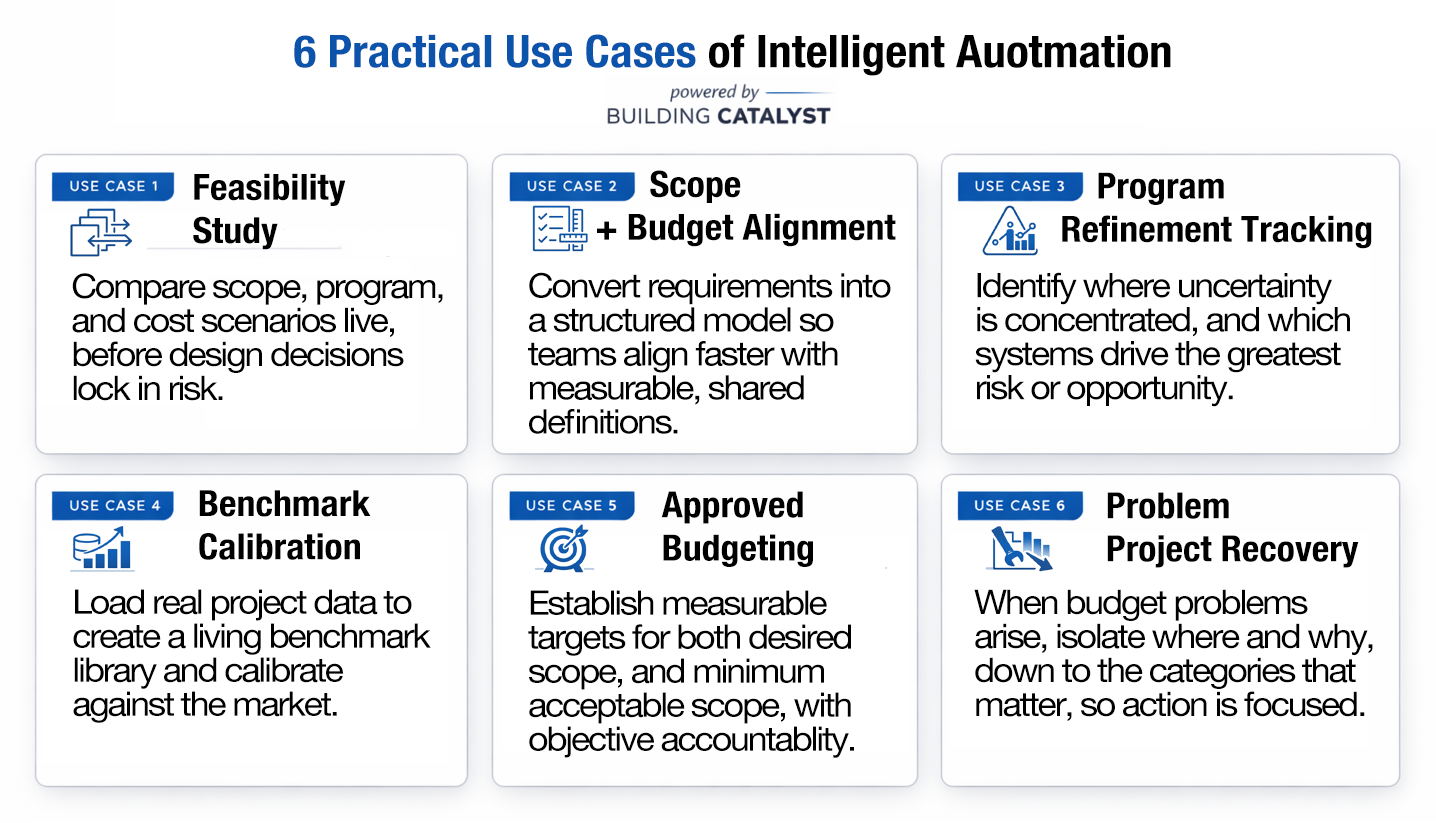
Use Case 1 – Feasibility Study A new space or building need has been identified, but there is no space program yet. Perfect. CATALYST enables you to model in real time from broad parameters, such as Surgery or Radiology department areas, or from a more detailed business case, such as MRI, X Ray, or Ultrasound, to model both the program and cost. You can run one or more new building, addition, and renovation combinations to determine which mix is feasible and make a clear project go or no go decision.
Use Case 2 – Scope and Budget Alignment Once a project go decision has been made, and before engaging your program and design team, CATALYST enables you to reliably balance your business case, project requirements, and scope to a budget or target value. You can evaluate multiple sites, requirements, and configuration combinations. Because the system operates in real time, you can perform rapid scenario planning until you settle on one or more preferred solutions and or a menu of alternatives that can be maintained for future adoption.
Use Case 3 – Program Refinement Tracking As the more detailed room by room space program and conceptual design are developed and refined by the team, the results can be mapped and imported into CATALYST to analyze program and design efficiency and to enable tracking and steering the design toward desired outcomes.
Use Case 4 – Benchmark Calibration If you, as the owner, or your advisor, designer, or builder have cost data from current or recently completed projects, it can be easily recorded in CATALYST. This creates a fresh, dynamic benchmarking resource from which to fine tune budget models based on known projects. CATALYST shows where variations exist between these benchmarks and national market baselines, making it easy to isolate and resolve potential gaps and overlaps.
Use Case 5 – Approved Budget or Target Value Development With a completed program and schematic design, the project budget and or target values can be established with greater accuracy. Often, there will be at least two budgets: one based on the fully desired program, requirements, and features, and another based on the minimum acceptable program and requirements. This provides the team with an impartial, measurable target to design and deliver toward the fullest desired scope attainable.
Use Case 6 – Problem Project Recovery For projects where a budget problem has occurred, CATALYST can quickly identify where the project varies most from market values for program, scope, and cost. Revealing the specific line items driving the variance is key to pursuing focused corrective measures.
These use cases all point to the same idea: early planning should behave like a live model, not a manual one off estimate and the dozens that follow. When program, cost, benchmarking, and scenario testing are connected in one system, owners can move faster and make better decisions with less risk.
A better way for early planning and cost management is now possible. Owners no longer have to rely on slow and biased estimating cycles to understand scope, cost, and risk. With intelligent automation, planning becomes a real time, impartial process where options can be explored, compared, and refined before major design commitments are made.
If you would like to see this industry-transforming process in action, watch the short Early Planning and Analysis videos below.
Or learn more at www.buildingcatalyst.com