

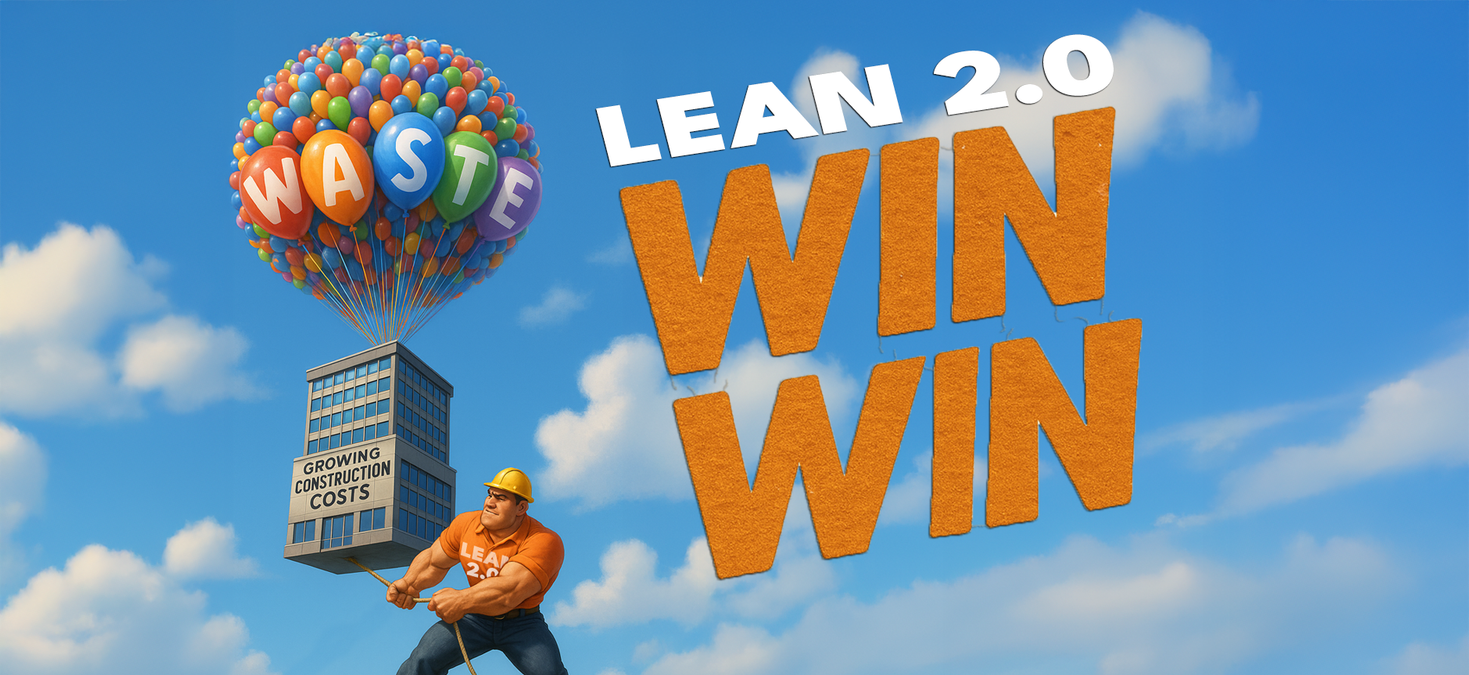
In our past dozen articles, we’ve shown how national data tells a compelling story: waste in planning, design, and construction is fueled by cost-based and billable-hour contracting — a win-lose model that continues to drive excessive costs unnecessarily. We’ve also highlighted the lessons from manufacturing’s turnaround, and the critical role of data standardization, applied research, and measurable, data-driven process improvement. This article builds on that foundation to explain how value-driven, win-win contracting works.
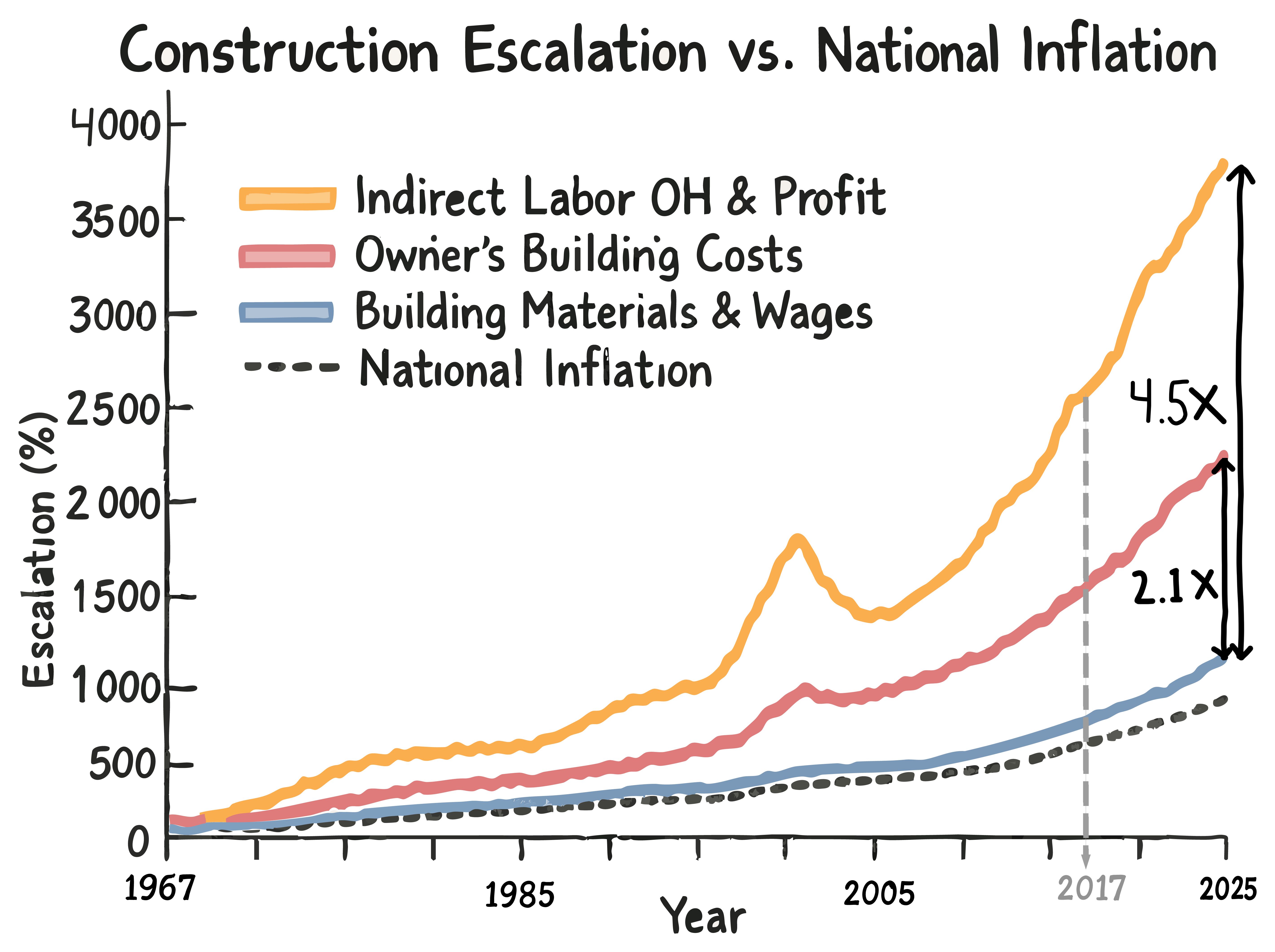
Construction is in a cost crisis. Buildings today cost more than twice their inflation-adjusted value, while overhead and non-value-added work have grown to more than four times what is necessary. Owners, customers, and taxpayers are paying the price.
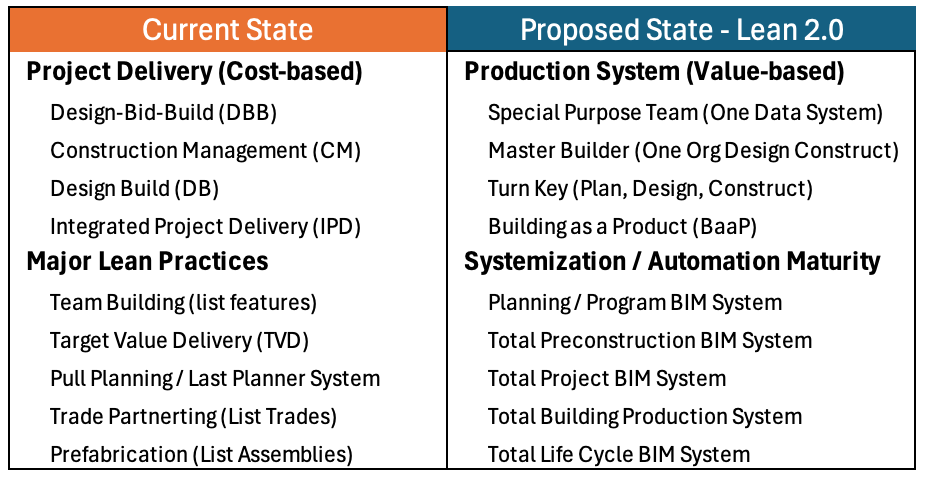
For the past five decades, the industry has been working hard to fix itself. Starting with Construction Management (CM) in the 1970s and then Lean practices in the 1990s, there has been a movement to reduce risk, improve relationships, and resolve conflict through collaboration. These efforts have been successful at reducing open disputes and fostering better teamwork.
Lean Construction seeks to eliminate waste and smooth project flow through respect, relationships, and continuous improvement — and in delivery methods like Integrated Project Delivery (IPD), it even aligns financial incentives to reinforce collaboration. Yet, ironically, while relationships have improved and conflict is now more often resolved collaboratively, these efforts have done little to reduce waste or overall project costs. In fact, national data shows the opposite effect: costs and overhead have continued to escalate at an excessive rate.
This isn’t just our conclusion. The 2017 McKinsey Global Institute report, Reinventing Construction: A Route to Higher Productivity confirmed a “consistent decline in the industry’s productivity since the late 1960s” and traced much of the problem to fragmentation and misaligned contractual incentives1.
Our data supports McKinsey’s conclusion about misaligned incentives — but shows the problem runs even deeper. Even when disputes are minimized and risk is managed, waste continues to accumulate. Why? Because today’s contracting structures reward time and cost, not measurable value. Owners lack visibility into what they are really paying for, while indirect costs and non-value-added effort are built into the process. This isn’t necessarily intentional on the part of builders; it’s the inevitable outcome of a system that ties profit to billable hours and higher costs, rather than to eliminating waste.
McKinsey identified seven areas of reform — from regulation and procurement to technology adoption and workforce skills. But without rewiring the contractual framework, there is little motivation to solve the other five.
To see why construction continues to struggle, it helps to compare it with manufacturing. Over the past half-century, manufacturers have achieved remarkable productivity gains. Their success stems from aligned incentives: the market sets prices, so companies can only improve profits by reducing waste, improving efficiency, and creating better products. Profits then fund reinvestment in smarter designs, streamlined production, and better technology — creating a virtuous cycle of continuous improvement.
Construction operates on the reverse formula. The greater the billable hours or cost basis, the greater the profit. Architects, consultants, builders, and even owners’ representatives are often compensated as a percentage of project cost or through hourly billing. Under this system, rising budgets increase profit potential, while efficiency and standardization reduce it.
Beginning with CM and Lean, the industry has made progress in reducing disputes and improving collaboration. But the financial logic hasn’t changed — and as nationally published data shows, overhead and non-value-added work have only expanded. The result is a win-lose dynamic: relationships look healthier, but owners and taxpayers continue to bear excessively escalating costs.
If the industry is going to escape this win-lose dynamic, it needs more than new tools or processes. It needs new leadership classes — professionals trained not only in AEC subject matters but also in W. Edwards Deming’s management philosophy and systems thinking.
Motivation drives transformation. When owners’ representatives, designers, consultants, and builders base their profits on measurable value improvements instead of costs and billable hours, the industry undergoes a profound shift. Waste becomes the primary target, and standardization, automation, and measurement — the pillars of Lean 2.0 — become the critical drivers of progress.
A new win-win era will require two key types of professional leaders:
Neither group can succeed alone. A connected network of program managers and building producers is essential to champion and drive the development of three critical Lean 2.0 strategies:
Together, these leaders will be motivated and equipped to eliminate waste, improve performance, and deliver higher-value buildings at lower cost. They form the human foundation of Lean 2.0 — the link between new incentives and the advanced means that follow.
If new leadership provides the foundation for Lean 2.0, then motivation is the engine that drives it.
Lean 2.0 rewires this compensation logic. Profit is no longer tied primarily to how much time or cost a project consumes, but to how much waste is eliminated and how much value is delivered.
Two transparent metrics make this possible:
Again, nationally published data shows non-value-added scope in construction is more than four times higher than necessary. By shifting compensation to reward waste elimination, consultants, designers, and builders can substantially increase profit per hour of effort, while owners see dramatically lower costs.
The calculation is straightforward. First, predict aggregated (not siloed) Tier 1 manhours and project market value based on the owner’s business case and project attributes. Then measure actual aggregated manhours and costs. The difference reflects the waste eliminated. That waste is then transformed into a shared win-win outcome: reduced costs for owners, higher profit per man-hour for delivery teams.
If motivation provides the “why,” then means provide the “how.” Once profits are tied to waste reduction and measurable value, the industry has every reason to embrace the tools and processes that make those improvements possible.
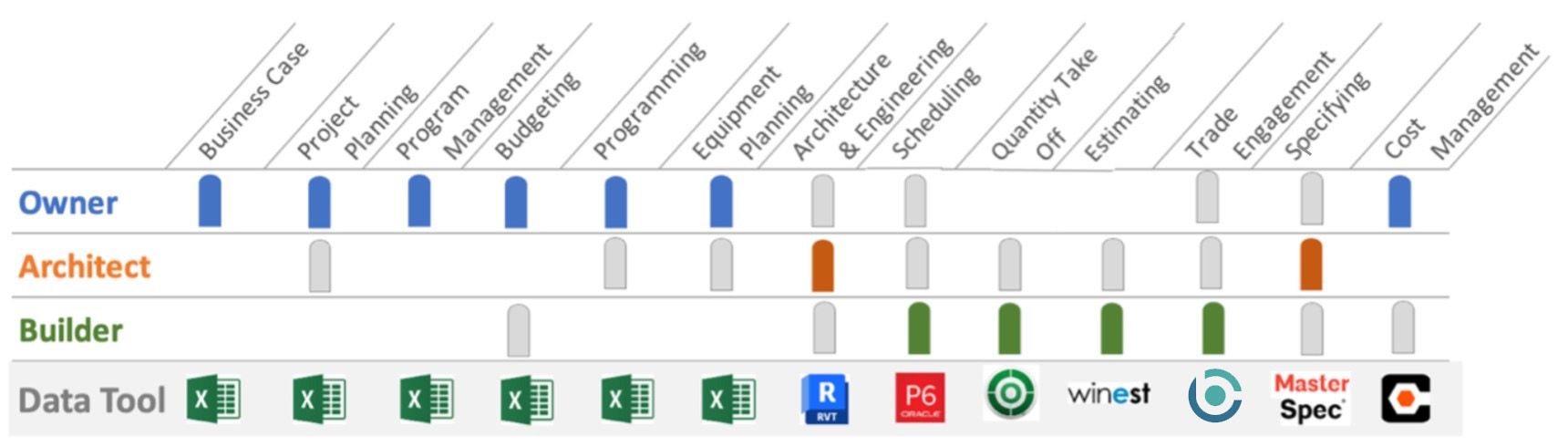
The greatest opportunity lies in overhead-driven waste — the general conditions, support labor, and home-office costs that ripple through every tier of the supply chain. Data shows that most of this overhead is unnecessary. It is sustained by fragmentation, manual data exchanges, rework, disputes, and overdesign.
Lean 2.0 introduces a systems-based alternative. By standardizing data, streamlining processes, and applying advanced automation, most of this overhead can be eliminated:
Figure 2 – Siloed Preconstruction Processes illustrates today’s reality: a maze of manual, repetitive, and fragmented handoffs. Lean 2.0 replaces this with a system that integrates data once and reuses it many times — cutting overhead by more than half and freeing teams to focus on real value.
This is not theoretical. Building Catalyst has already developed and tested advanced automation capabilities starting from early planning. Combined with Deming’s management philosophy, these tools empower the new generation of program managers and building producers to identify, measure, and eliminate downstream waste.
The promise is transformative - even audacious: a 90% reduction in effort for planning and budgeting, overhead costs cut in half, and measurable improvements in cost certainty, schedule reliability, and building performance. With the right motivation and the right means, construction can finally move from a waste-heavy process to a win-win system of value creation.
The shift to Lean 2.0 doesn’t have to wait for industry-wide reform. Any team, on any project, can begin testing a win-win, value-based approach today. At minimum, it provides insights grounded in real market data. At best, it transforms significant waste into measurable value and profit.
Consider a common scenario: an architect develops schematic designs under a traditional fee proposal, while a construction manager submits a detailed budget estimate. Traditionally, this locks the owner into a cost-heavy path with little recourse. But with Building Catalyst, you can create multiple market-aligned cost models at this early stage, compare them to the detailed estimate, and highlight deviations from baseline.2
From there, a win-win alternative plan emerges:
This approach turns conflict into collaboration not only in relationships, but also in economics. Waste becomes profit, owners realize dramatically lower cost, and delivery teams achieve a higher return on effort.
The message is simple: there is no need to wait. The tools exist, the data is available, and the framework is ready. Lean Construction 2.0 offers the industry a way out of its paradox — moving from win-lose to win-win, and from fragmentation to a system of measurable value.