


For more than eight decades, construction has been stuck in a Groundhog Day loop—repeating the same monotonous and costly process, project after project. Unlike Bill Murray’s character, the industry hasn’t learned from each repetition. Without consensus-driven data standards and a robust, data-powered knowledge system, every project is reinvented from scratch—costing owners double the inflation-adjusted value for their buildings.
The absence of an industry-wide data framework applied with fidelity forces teams to manually re-create the scope, program, budget, design, and construction support efforts from scratch on every project.
Organizations like ASTM and CSI have recognized the importance of this challenge and attempted to address it. CSI’s MasterFormat, UniFormat, and OmniClass provide a foundation, while the BIMForum’s Level of Development (LOD) standards have advanced detailing practices. Yet these standards remain incomplete, inconsistently applied, and riddled with errors—keeping planning, design, and construction support efforts shackled to inefficiency.
The concepts are sound; the application is not—as confirmed by several ENR Top 100 builders.
We conducted the National Standardization and Modernization Survey—the first of its kind—asking estimators and preconstruction leaders about current practices and their interest in advancing historical data analysis and benchmarking through cost standardization, thereby modernizing the preconstruction process.
This survey quantified the problem, starting with cost standards. From an initial subset of UniFormat Level 1 standards—A (Substructure), B (Shell), and C (Interiors)—taken to Level 3, the structured feedback revealed 25 top ASTM failures.
For example:
The following findings provide a dramatic call for high-fidelity standards development in the construction industry.
When elements are placed consistently, data becomes exchangeable and comparable. Cost fidelity means harmonizing and enforcing clear inclusion/exclusion rules—especially at UniFormat Level-3 detail and system interfaces.
Fixing inconsistencies (Step 1) is essential, but sustaining improvement requires a deeper shift—from fragmented tasks to a unified, purpose-driven system.
As described in The Power of Knowledge to Reinvent Construction, process improvement pioneer W. Edwards Deming taught that every team and project must be understood and managed as a system, with clear aims, defined processes, and continual learning through feedback loops. Without this systemic view, every party focuses on optimizing its own part to the detriment of the whole project—as the doubling of cost has shown.
Toyota embraced Deming’s philosophy and operationalized it through what became the Toyota Production System. By aligning all activities and data around purpose—and by creating cause-and-effect relationships between inputs and outcomes—they made improvement a natural, repeatable process.
Their 5S strategy (Sort, Set in Order, Shine, Standardize, Sustain), reinforced by Plan–Do–Study–Act (PDSA) cycles, ensured that every change was tested, measured, and refined.
Figure 1 shows Building Catalyst's applied construction version of 5S, adapted to:
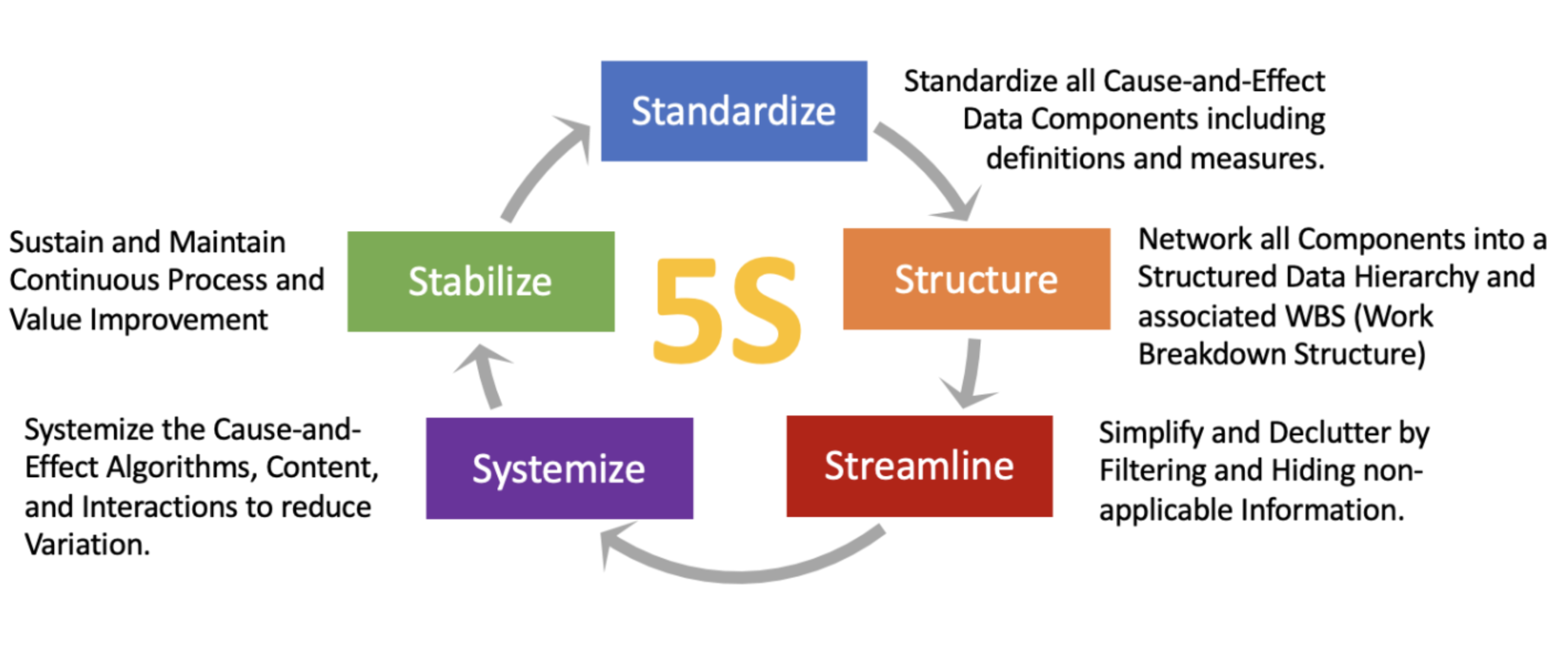
By organizing all data and processes around a facility’s purpose, planning, budgeting, design, and construction management can be transformed from silos to a system.
Buildings are not just collections of parts—they are complex systems within systems. A medical center, for example, is a system of functions (such as MRI or Ultrasound), organized by departments like Radiology. The program, design requirements, and cost intensity of an MRI are far greater than those of Ultrasound, and Radiology is far more resource-intensive than physician practice spaces.
Standards like CSI OmniClass Tables 11, 12, and 13, and healthcare guidelines from the Facility Guidelines Institute (FGI), provide valuable functional definitions. But they remain static, isolated objects. They do not create the cause→effect structure needed to systematize—and ultimately automate—planning, design, and construction management.
As shown in Figure 2 – Building Catalyst: Construction as a System of Critical Data – everything from a building’s purpose (cause/inputs) to its cost (effects/outcomes) can be standardized. The Pareto (critical few) approach to structured (parent–child) data in complex systems like construction is essential.
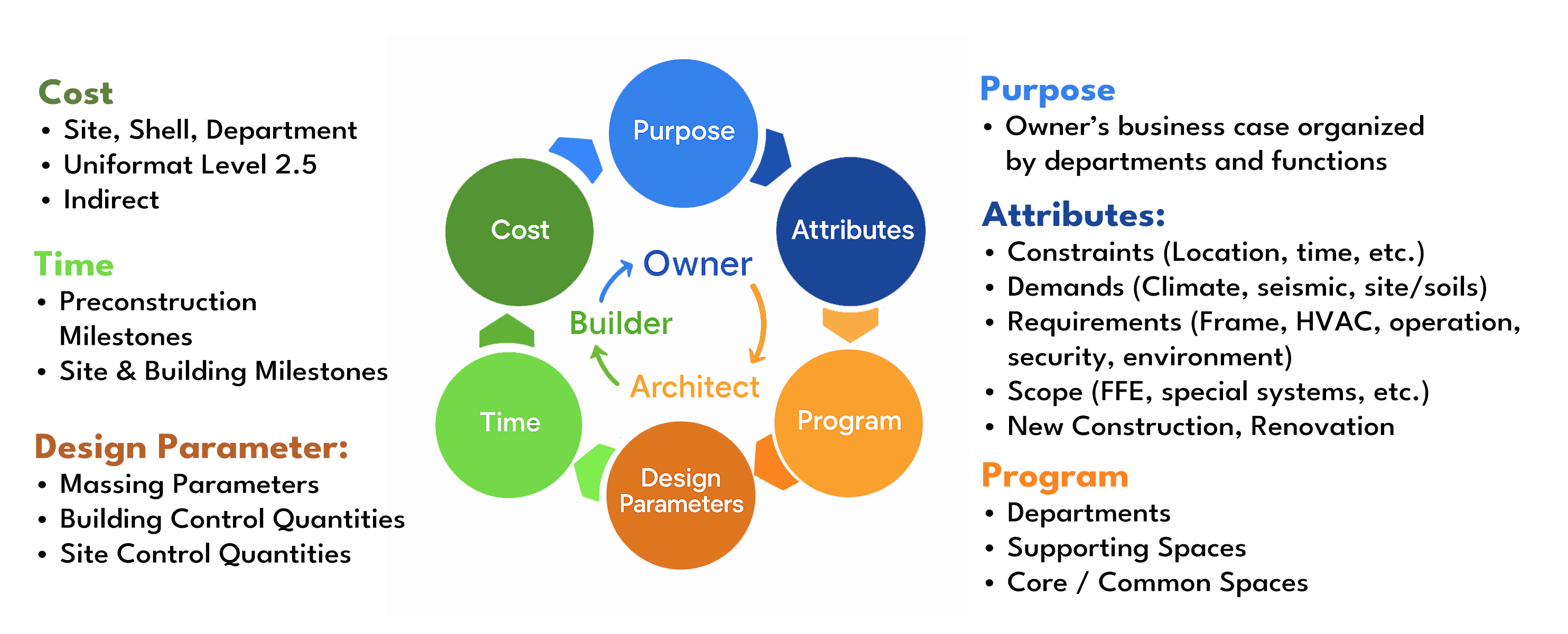
Today, only a few causal attributes—such as Seismic Design Category (SDC) or quality ratings (BOMA Class A, B, or C for commercial, Stars or Diamonds for hospitality) have tried to standardize. The missing link is a comprehensive, dynamic framework that connects all relevant building functions and attributes to their effects—enabling the kind of systemic improvement Deming developed and Toyota proved possible.
Deming taught that without measurement tied to purpose, improvement is impossible. He proved that when you connect every input to its outcomes, you can measure cause-and-effect to learn faster and improve continuously.
In construction, this principle takes the form of a Context Schema—a standardized framework linking a building’s purpose and attributes to its cost, time, and performance outcomes.
The Context Schema transforms static standards into a living cause→effect model. It captures a compact, consistent set of project-defining information—recorded alongside cost codes—so that every decision, from early planning through construction, is informed by comparable, purpose-driven data.
This allows for accurate prediction, reliable benchmarking, and full PDSA learning and process improvement cycles.
By adopting this schema, construction can finally align with Deming’s vision: manage the whole as a system, measure relentlessly, and improve continuously. It is the missing bridge between today’s fractured processes and a true industry-wide learning loop—turning every project into both a successful build and a source of actionable knowledge for the next.
The heart of Lean Construction 2.0 is the ability to connect purpose, context, and cost into a continuous learning loop. Any organization can begin by adopting a proven context schema—linking standardized purpose and attribute data to cost codes, measuring results, and refining based on evidence.
This transforms static information standards into living knowledge tools that get smarter with every project.
The principle is universal and must be applied industry-wide: standardize and systemize where possible, measure relentlessly, and adapt based on evidence.
Until industry-wide standards are developed, Building CATALYST platform provides a data science–driven approach to planning and cost management, using placeholder standards that can be refined and scaled. There’s no need to wait to start experiencing the benefits of systemization and standardization. Learn more at www.buildingcatalyst.com.
Breaking the 80-year time warp won’t happen through partial fixes or well-meaning collaboration alone—it demands fidelity to shared standards and a system that makes learning automatic.
By pairing consistent cost coding with a structured Context Schema, we can turn static benchmarks into a living, evolving knowledge base. This is how other industries have broken free from stagnation—and how construction can, too.
The tools exist. The principles are proven. What’s left is the will to act—project by project, dataset by dataset—until waste is driven out and value becomes the standard.
Construction needs its leaders—owners, developers, owners’ reps, architects, engineers, builders, researchers, educators, technologists, and systems thinkers from all corners of the lean community—to embrace consensus data standards and structures.