

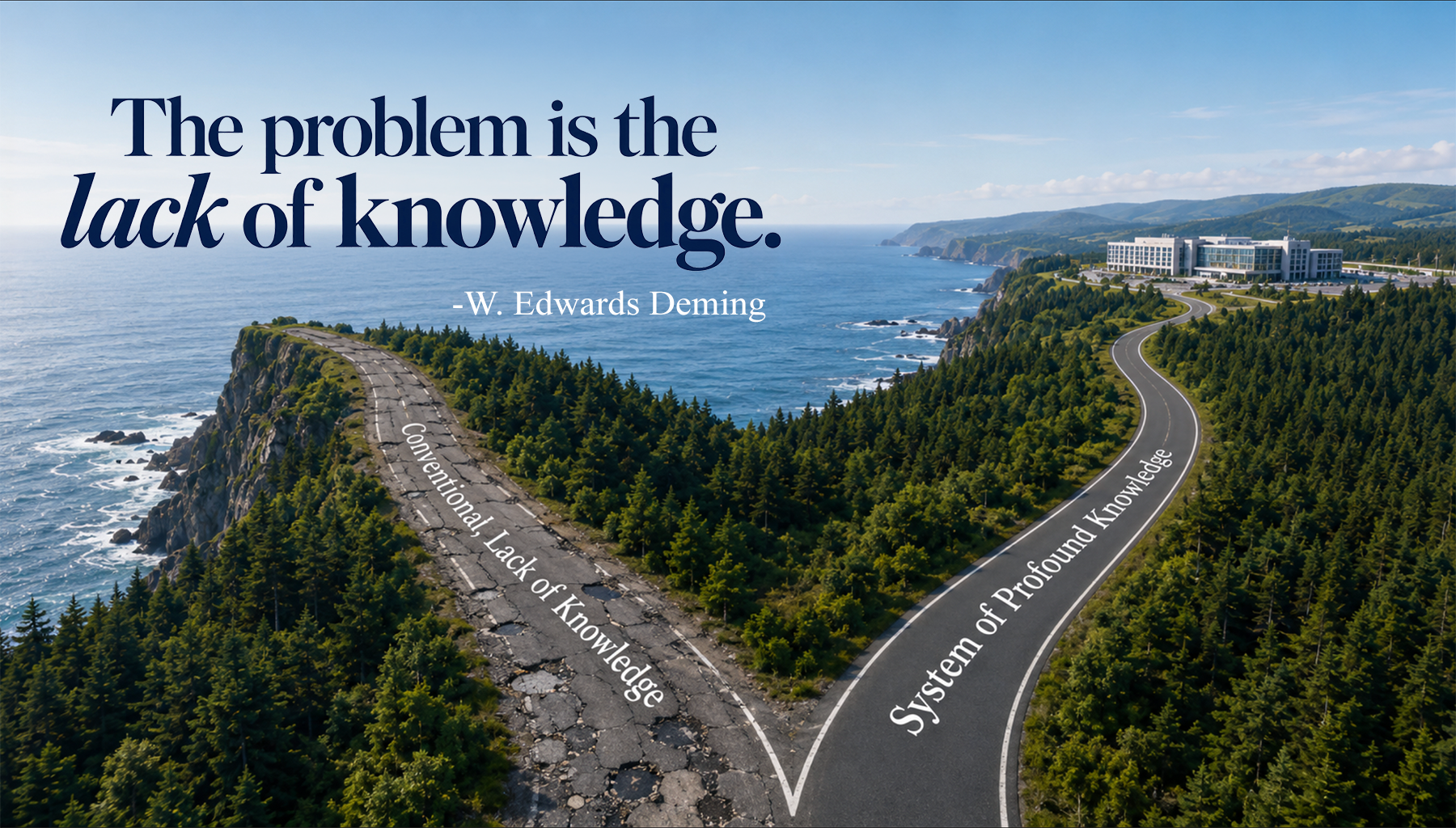
Our industry’s severe stagnation and waste (in time and cost) has led us to a historic fork in the road. One road is conventional. It stays the course but looks to AI as the principal source of knowledge and agent for improvement. The other is a new road. It requires a complete replacement of the prevailing management philosophy and financial reward framework. This road looks to AI as a supporting agent.
This article advocates for the second road, or "Construction as a System". Thanks to W. Edwards Deming's knowledge system, working in collaboration with data science, we have a solution and a road map similar to that which transformed post-WWII Japanese manufacturing. It presents a more holistic picture of Deming’s System of Profound Knowledge - an important precursor to the road map presented in The Case for Construction as a System.
Deming said that the, “two basic rules of life are: 1) Change is inevitable. 2) Everybody resists change."

For starters, we must understand that reform requires a radical change in today’s prevailing management philosophy and mindset. As offensive as it may sound, the data speaks the truth about how severely fragmented and archaic our industry has become.
Industry leaders are not accountable for today's massive construction problem that's been five decades in the making, and they should not take offense at the data or the claims made while studying it. Industry leaders, however, having seen the data have a great opportunity - and a responsibility - to consider solid solutions.
A glimpse of the contrast between the conventional and proposed new road is envisioned in the following videos. The new road features remarkable advances in the acquisition and application of objective (profound) knowledge and automation - or what we refer to as an Intelligent Automation System (IAS).. These advances are designed to inspire and fuel operational excellence within and across organizations: owners, consultants, designers, builders, and trades.
It is vital to note that current conventional information resources and construction technologies all operate within their discipline silo. This includes space programming, BIM, Estimating, Scheduling, Contract Management, etc. - all of which require manual exchange of data. Instead, the two videos demonstrate for the first time how critical data from all disciplines and sources can and should be integrated into a system. At its core, Construction as a System is not a technology strategy. It is a management, knowledge, and operating system in which technology and AI serve as powerful supporting agents.
To understand that distinction and why this second road is fundamentally different from the first, we must examine the philosophical and intellectual foundation upon which Construction as a System is built, namely W. Edwards Deming’s System of Profound Knowledge."
Let’s take a very high view of Deming and his System of Profound Knowledge.
Dr. Deming was the quality and process improvement pioneer sent by General McArthur to help rebuild Japan’s post-WW-II economy. Deming’s management philosophy and systems thinking had a profound impact on Toyota. From a tiny automaker to global dominance, Toyota forced Ford, GM and other automakers into adopting Deming philosophy and thinking - albeit to a limited degree.
The origin of today’s lean construction movement is based largely on the Toyota Production System. Many, if not most of today’s lean practices are structurally solid but have not been able to overcome the core financial reward and misaligned incentives problems as described throughout this series of articles.
Although Dr. Deming never faced challenges as complicated as those in the construction industry, every aspect of his System of Profound Knowledge is applicable to it.
Given the scope and complexity of the problems that construction must solve, it may have an even higher potential impact than in manufacturing.
To understand that distinction—and why this second road is fundamentally different from the first—we must begin with the intellectual foundation upon which Construction as a System is built: W. Edwards Deming’s System of Profound Knowledge."
Deming’s System of Profound Knowledge includes four parts:
Future articles will delve deeper into the elements of each section as they relate to real-world projects and solutions. To summarize, I believe these highlights provide a good starting point.
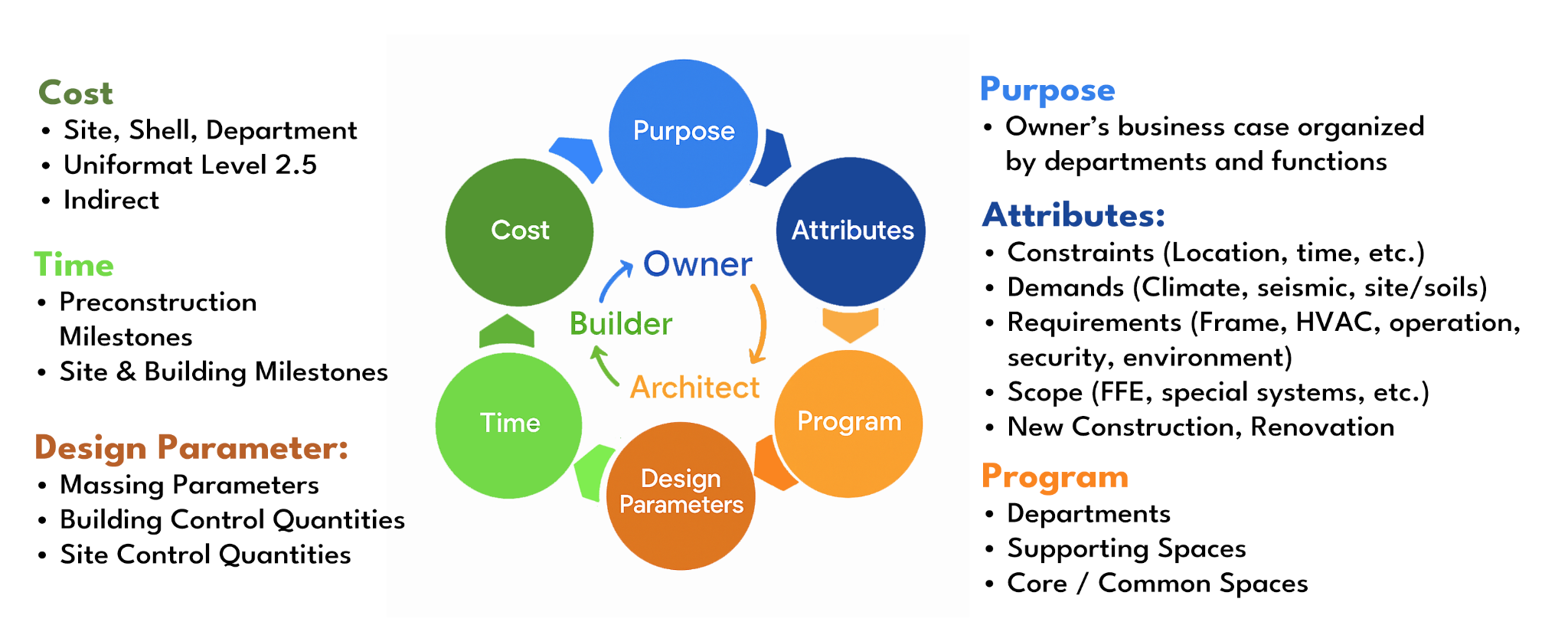
Dr. Deming defined a system as “a network of interdependent components working together to accomplish the aim of the system.” Figure 1 shows how all critical components are networked into a system.
In construction, that system must be built around shared standards, integrated data, and a common purpose—beginning in the earliest planning stages. Only then can the entire team work with confidence toward a shared aim: increasing value by continually eliminating waste.
From owner, to consultants, to designer, to builder, to trades —leadership must drive adoption of this system, across the system partners and within their own organizations.
Leaders must seek the success of the system and everyone in it, not just their own organization’s reward. Why? Because self-interest destroys system balance. Business relationships must now move toward true win-win collaboration. Deming thinking affirms that a win-win, value-driven contracting and reward system is essential to project success.
The planning, design, and construction of complex, custom-designed buildings have suffered from the lack of an effective, objective knowledge system. But when critical components are connected through measurable cause-and-effect relationships, as shown in Figure 1, objective knowledge—the ability to predict outcomes and make informed decisions or corrrections—becomes possible. As shown in Figure 2, the scientific method can then enable both transformative innovation and continuous, measurable improvement in process and value. Construction has lacked this kind of systemic framework for learning and measurable improvement throughout the post-industrial era.
Deming and Shewhart pioneered this through the PDSA (Plan-Do-Study-Act) Cycle.
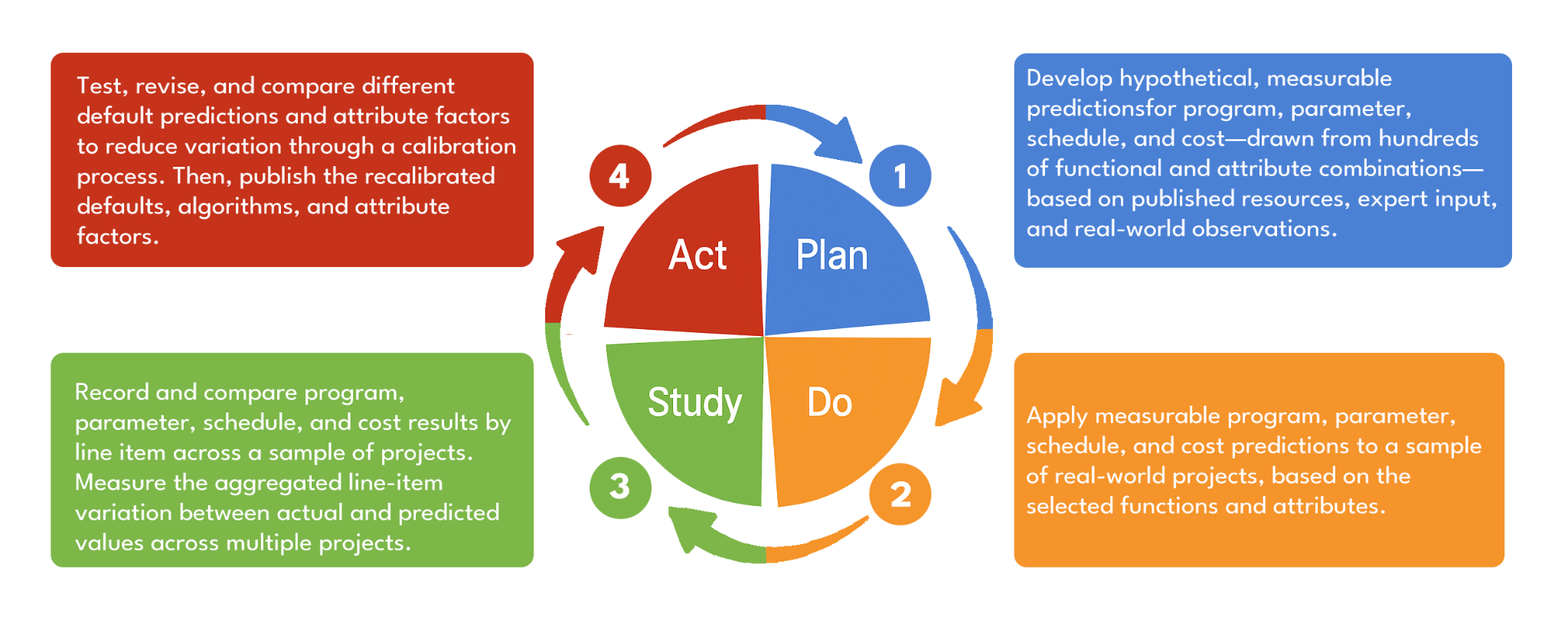
In construction, the more complex the project, like hospitals, the more vital this cycle becomes for learning, innovation, impartial valuation and cost management.
Without it, project teams remain trapped in a reactionary, one-off cycle—making decisions without a system, repeating the same mistakes, and lacking the insight to improve.
You can’t improve what you can’t measure. Objective measurement—against impartial standards—is key to flipping from cost-plus and billable-hour to value-based contracting.
Dr. Deming said, “If I could reduce my message to management to just a few words, I'd say it all has to do with reducing variation.”
He taught that production isn’t improved by measuring production, but by understanding and reducing variation (aka waste, rework, defects).
In construction, PDSA learning only works when you measure actual vs. predicted outcomes—tracking variation. This is where meaningful measurable improvement starts.
Yet, current compensation structures do the opposite:
Without a knowledge system, high variation becomes the norm. The fact that hospitals today cost more than three times what they should and that their non-value-added costs are more than six times higher indicates that we have no means of measuring variation (i.e., waste, defects).
The crisis in hospital construction is so entrenched that a complete, albeit simple, shift in thinking is required. The Deming worldview, management philosophy, and systems thinking is the answer.
As Dr. Barbara Berry explains in her essay, There is a Relationship Between Systems Thinking and W. Edwards Deming’s Theory of Profound Knowledge, “Profound knowledge generally comes from outside the system and is only useful if it is invited and received with eagerness to learn and improve.”
Organizations cannot understand themselves fully from within. Objectivity requires an outside perspective. But that’s impossible under today’s secrecy and non-disclosure (NDA) culture. As Deming put it, “A change in philosophy requires unlearning industrial thinking evident in departmentalization, scarcity of knowledge and information competitiveness."
Owners and industry leaders must rethink the NDA mindset. Without shared information, we cannot achieve the impartial analysis needed for measurable improvement. Those clinging to proprietary data will be left behind—as customers and competitors embrace transparency, measurement, and knowledge-based performance.
Dr. Deming was a devout Christian with a deep understanding of God's design of man in symbiotic cooperation. His system of psychology, described in Chapter 3 of “The New Economics” applied 1 Corinthians 12:14-21 to metaphorically describe how the body worked through its cooperative parts.
Today’s complexity science and multivariate analysis (MVA) can wrangle layers of interconnected data (parts of the body) for acquiring profound knowledge about construction. Beyond data science, impartial analysis, statistics, and process control, however, Deming was interested in human relationships and called leaders to lead relationally. Rather than individual or organizational self-interest he understood that the well-being of the whole system was essential. Of the many passages that reflect this, Philippians 2:3–4 is particularly relevant: “Do nothing out of selfish ambition or vain conceit. Rather, in humility value others above yourselves, not looking to your own interests but each of you to the interests of the others.”
The point is that we can now apply advanced systems, technology, contracts, and controls to solve extraordinary problems. Above all, however, is the inner motivation and ability to think beyond the here and now to create lasting impacts on people while at the same time design and produce beautiful, high-performance buildings that will last far beyond our lifetimes.
It is not necessary to share Deming's Christian faith in order to appreciate the importance of these principles . It is true, however, that reform will require the same fundamental shift in mindset: away from optimizing individual interests and toward creating a Deming-based system in which every participant can succeed by increasing the value of the whole.
Construction stands at a fork in the road. Most will likely stay on the current, conventional road, attempting to enhance a fragmented system with better tools and AI.
Some, hopefully, will consider the second road, which involves Deming’s management philosophy, knowledge system, and win-win, value-based contracting framework that will change how the industry operates.
For those interested in the second road, The Case for Construction as a System presents the reasons why, and the means for any owner and team to try it out.
When ready to take next steps, or learn more, please visit www.buildingcatalyst.com.