
Arguably, the most consequential and dangerous phenomenon in the history of building construction continues with no apparent end in sight. That the phenomenon can now be measured provides an analytical breakthrough needed to avert construction's contribution to an economic disaster similar to that created by the 2008 subprime mortgage crisis.
The data clearly shows, for example, that instead of the tens of millions of dollars in excessive cost, multiple healthcare systems are now paying hundreds of millions more than necessary on a single hospital project.
Recent, compelling data findings and analysis show a strong correlation between these extraordinary costs and the growing adoption of Integrated Project Delivery (IPD). The analysis is simple. IPD has taken cost-plus and billable hour compensation scope from the 1st tier builder to the 2nd tier trade contractors and prefabrication providers.
Decades of growth in construction management (CM), that applies first-tier cost-plus and billable-hour compensation models, have paralleled a sustained trend of construction cost escalation exceeding national inflation.
IPD began to grow throughout the 2000s and 2010s, starting with the mechanical, electrical, plumbing (MEP) trades and then expanding to other trades and incorporating prefabrication assemblies.
As IPD gained traction the cost-plus and billable-hour scope expanded - from less than 10% (1st tier builder) of the project to more than 50% (2nd tier and Prefab) - a huge surge in owner cost burst forth starting a few years prior to the Covid pandemic.
A universal maxim is at the core of the problem: you get more of what you reward. Cost-plus and billable-hour compensation rewards higher costs and more billable hours. It was bad enough at the first tier (CM), but the situation is now being pushed to alarming and unsustainable levels by extending it to the second tier through the growing adoption of IPD..
IPD could provide an effective and efficient design and delivery approach if the misaligned compensation structure were reversed. This would require the financial motivation to earn a return-on-effort to be aligned with an intrinsic motivation to produce customer value through operational excellence.
This is the 24th article in an in-depth series examining the construction industry’s persistent stagnation and the seemingly inexorable escalation of costs now accelerating under IPD. The series explores the historical background, underlying causes, and systemic failures driving these problems, developing both philosophical and technical analyses of their origins and proposing solutions capable of addressing them at their roots. Explore the full series at Building CATALYST Insights.
The proposed solutions presented essentially translate W. Edwards Deming's work in manufacturing to construction - and the development of the Construction as a System (CaaS) alternative to today’s fragmented and archaic processes. His win-win management philosophy, complexity science and knowledge system transformed Toyota and manufacturing. The same principles can now be applied through CM, IPD, and, most especially, Design-Build delivery approaches to reverse the traditional compensation framework while infusing the highest levels of automation and operational excellence.
The timing for Construction as a System (CaaS) is particularly compelling, as AI is creating a strategic inflection point for the construction industry—one that should help eliminate layer upon layer of billable and non-billable hours. Why not consider the CaaS alternative that generates a greater return-on-effort when eliminating those hours? This reality applies to consultants, designers, as well as builders and trade contractors.
The balance of this article examines the data discoveries that show the looming disaster if cost-plus and billable hour compensation IPD continues to expand.
_____________
Annual construction volume now exceeds $2 trillion in the US. Even prior to the revelation of the surge IPD-correlated cost, our industry’s decades-long productivity stagnation resulted in construction cost escalating to more than double the inflation-adjusted value for buildings1,2,3.
“The findings so far, from an in-depth data analysis of 37 hospitals, indicate a great looming construction disaster.”
Our hypothesis, at Building CATALYST, is that further correlation-to-causation data research and analysis will enable us to measure the added impact of cost-plus and other current practices across all building sectors. The findings so far, from an in-depth data analysis of 37 hospitals, indicate a great looming construction disaster.
This data analysis shows that multiple hospital projects using IPD are reaching costs that exceed $1 billion over their inflation-adjusted value. Yet, despite growing public concern over the rising cost of healthcare, there is virtually no discussion about the contribution of hospital construction to that burden.
Where health systems fail to push back, building teams applying IPD practices have been allowed to overreach - to extraordinary levels in some cases. The growth of IPD across other market sectors necessitates a broader scope of data collection and research to assess its impact at the national level.
An Examination of Critical Data Discoveries
Let’s look at the essential findings of the hospital data research and analysis. Among the dozens of metrics available, we will focus on three key indicators: Cost per Operating Room; Mechanical, Electrical, and Plumbing (MEP) Costs; and Indirect Costs—including the builder’s General Conditions (GC), General Requirements (GR), Overhead (OH), and Profit.
As shown in Figure 1, an operating room (OR) would cost approximately $2.2 million if its construction cost had increased only at the rate of national inflation. If costs had instead risen at the average rate for all building sectors (per published Construction Analytics data), the same OR would cost approximately $4.7 million—more than twice the inflation-adjusted estimate.²˒³ However, the data analytics reveal that actual OR construction costs have risen substantially beyond both benchmarks. A strong correlation in the data indicates that health systems are paying nearly three to more than five times the amount justified by inflation alone, raising questions about the factors driving these additional costs.
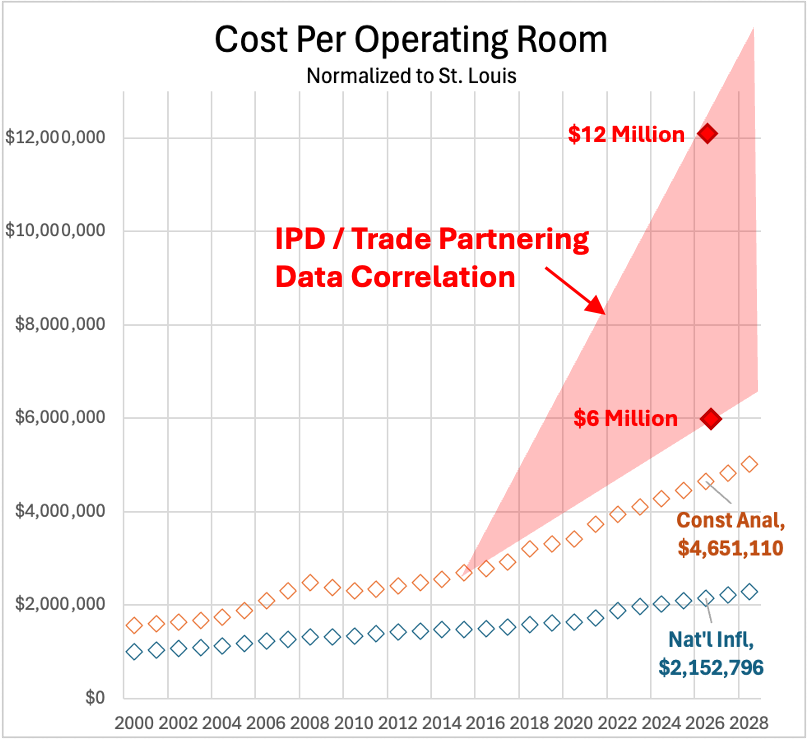
The financial incentive to design, budget, and build projects at the highest allowable cost is a fundamental problem that must be addressed.
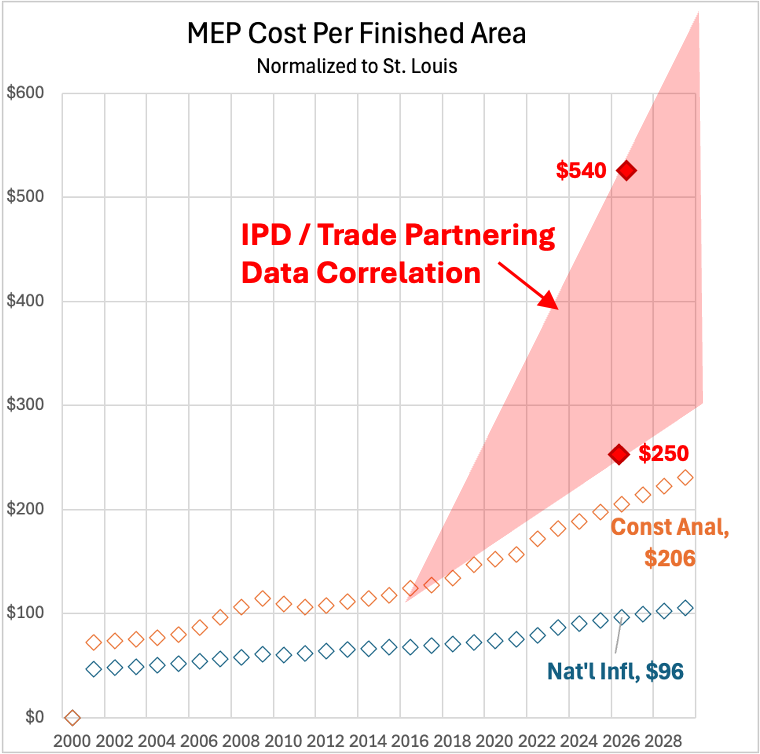
Every trade is influenced by misaligned incentives. Although negotiated trade partnering is intended to improve owner value, the data indicated that these practices produce the opposite effect. The mechanical, electrical and plumbing (MEP) trades are usually the first partnerships to be engaged. In Figure 2 we see the MEP cost trend that shows why operating rooms, like every other hospital function (aka key planning unit (KPU)) is escalating beyond imagination.
Finally, let’s examine the trend in indirect costs. When expressed as a percentage of direct costs, the growth in indirect costs does not appear as alarming. However, because IPD drives direct costs upward, a more meaningful metric for evaluating indirect cost growth within a specific building type, such as hospitals, is cost per finished square foot (SF). Figure 3, therefore, reveals a similarly steep upward trend in builders’ general conditions and requirements, permits, insurance, bonds, overhead, and profit.
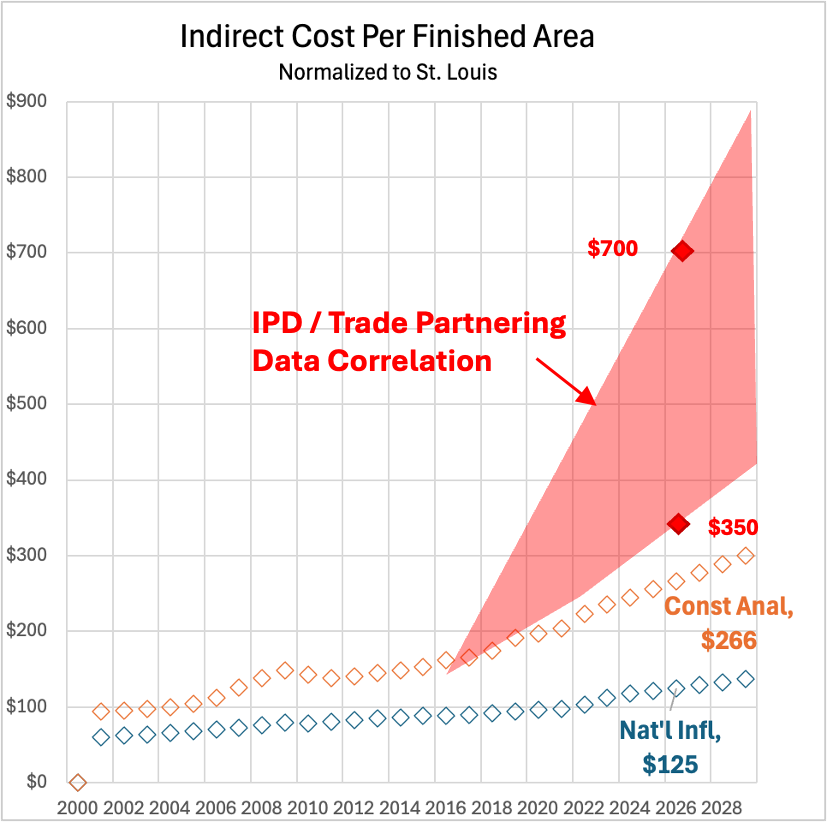
It is worth noting that the direct and indirect costs per unit of finished area contribute even more to the cost per OR, for example, as the total building area since before Covid has been increased in many cases.
By 2025 annual construction volume in the US surpassed $2 trillion, of which half was over-inflated. The 37-hospital data study strongly suggests that an IPD movement, if allowed to expand, has an exponential impact that’s driving waste in costs and unnecessary supporting labor effort. To put into perspective - that our now $40 trillion in national debt is growing by up to $3 trillion annually – construction waste and abuse could equate to more than half.
The well-intentioned IPD movement has helped projects run more smoothly, reduce claims and disputes, and improve the likelihood of on-time, on-budget delivery. Many of its core practices—including trade partnering, early collaboration, and prefabrication—also offer tremendous potential to dramatically reduce construction waste.
However, these benefits can become detriments when IPD is coupled with a misaligned compensation framework. Cost-based, cost-plus, and billable-hour compensation models incentivize higher budgets, greater spending, and increased labor demands rather than cost efficiency, innovation, and the achievement of measurable value outcomes.
The proposed Value-based Contracting System addresses the compensation problem by combining impartial market intelligence with a framework designed to reward measurable improvements in value and efficiency. We explain the approach in The Case for Construction as a System.
The big question is whether owners and industry leaders are willing to change the compensation practices that sustain excessive costs, even when doing so challenges established profit generation frameworks.
If owners and leaders are willing to change, then the other benefits that IPD provides will be enhanced. If not, IPD will remain as a useful agent to drive waste and inefficiency on many projects. The Design-Build approach provides a more inherently integrated framework. The Design Build Institute of America (DBIA) provides the framework, network, and resources. Our DBIA blog post The Need for Highly-automated, Systems-based Design-Build presents an alternative to IPD worth considering.
Our primary construction reform goal for 2027 is to help build a coalition of professionals and leaders willing to examine the data, test proposed solutions, and advance meaningful reform.
We need owners, owner-advisors, architects, engineers, builders, educators, and researchers who will bring their knowledge and professional judgment to this effort. That includes a willingness to engage in more comprehensive and applied data research.
Reform requires courage and conviction expressed through action: questioning accepted practices, demanding credible evidence, and holding ourselves accountable for the value we deliver.
To join the effort or learn more, visit www.buildingcatalyst.com and get in touch.
End Notes:
1 Building CATALYST - Applying MVA (multivariate analysis) in March and April 2026 - CATALYST performed micro-economic analysis of 35 hospital projects, spanned multiple regions, owners, designers and builders, with project data anonymized for confidentiality. Two hospital projects have since been added that show continued excessive escalation.
2 Bureau of Labor Statistics (BLS), "Producer Price Index (PPI) for Construction Inputs and Employment Cost Index (ECI)," U.S. Department of Labor (1970–2026).
3 Ed Zarenski, Construction Inflation 2025 Update (Nov), Construction Analytics, November 13, 2025.