


It just makes sense to move beyond archaic ‘stick-built’ methods toward manufacturing-inspired approaches—commonly referred to as Industrialized Construction (IC). The IC movement intends to answer McKinsey’s call for breaking free from the circa-1945 time warp holding the industry back, as described in Reinventing Construction: The Route to Higher Productivity.
The IC spectrum runs from ad-hoc prefab assemblies and pods (bathrooms to MEP rooms) to full modular buildings delivered on trailers and snapped into place like a Lego set.
But here’s the paradox. First, IC strategies do not resolve the excessive doubling of owner costs beyond their inflation-adjusted value. In fact, in many cases they layer on even more cost. Second, full modular buildings have limited application because they sacrifice functional flexibility, design creativity, and the beauty that custom designed buildings can offer.
Lean construction rightly advocates for IC but, at best, have to admit mixed results - as summarized in this: Compilation of IC Studies.
This article presents combined Lean 2.0, Intelligent Automation System (IAS) and IC strategies that apply the same management philosophy and system-based approaches that transformed Toyota and manufacturing. The result is that high-performance buildings - from custom to modular - can be produced for a measurably lower cost and delivered much earlier.
To understand how, let’s look at the math.
Nationally published cost data together with the Construction Industry Institute CII Report 191 shows that only about 20% of an owner’s building cost comes from direct material and labor. The remaining 80% consists of indirect and non-value-added scope as shown in Figure 1.
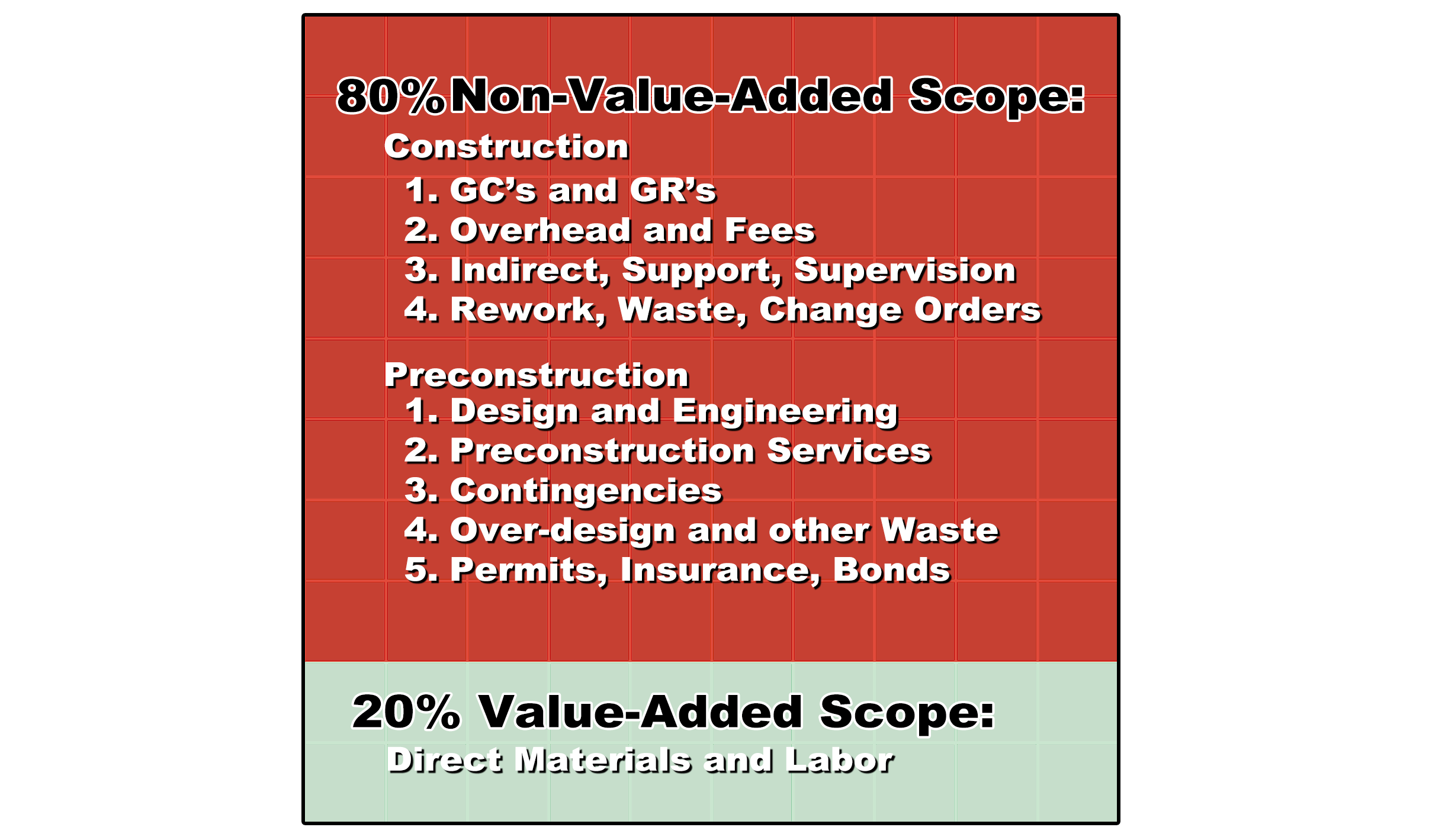
Here’s how that 20%–80% split plays out in cost terms. Suppose an IC strategy, in a worst-case scenario, increases direct material and labor by 40%. Because direct costs make up just 20% of the total, the overall project cost would only rise by 8% (=20% × 40%). That’s not catastrophic—but it certainly doesn’t deliver the promised savings, nor does it address the already excessive cost surges.
Now consider the other side of the equation: reducing the 80% of non-value-added scope by just 10% (=8% ÷ 80%) fully offsets that increase. In practice, Lean Construction 2.0 aims for reductions well beyond 10%—which means the time, labor, and quality benefits of IC can finally translate into real, measurable savings for owners.
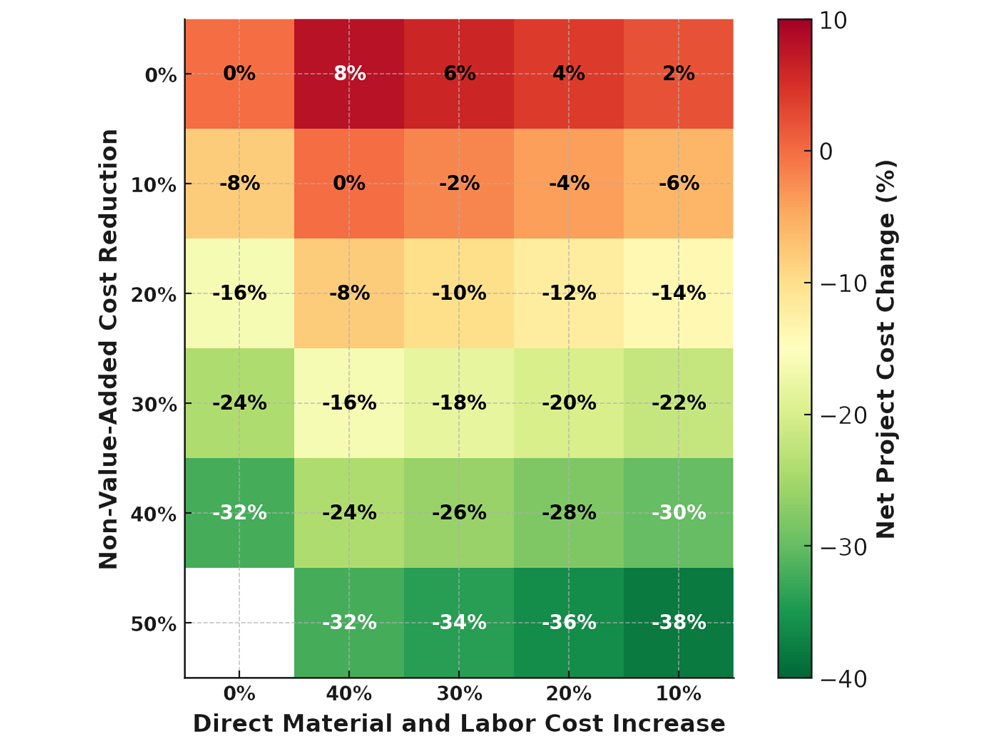
This matrix shows how changes in direct material and labor costs (horizontal axis) interact with reductions in non-value-added scope (vertical axis).
The conclusion is clear: Lean 2.0 and IAS offers the larger near-term opportunity, but the combination of Lean 2.0, IAS and IC unlocks the breakthrough. These claims are grounded in both nationally published macroeconomic data and detailed microeconomic project evidence.
That IC alone struggles to reduce cost, surely its biggest opportunity lies in time. Unlike cost, there are no reliable national datasets tracking preconstruction or construction durations. Yet time is money—and it is essential that the industry begin collecting, processing, analyzing, and testing real-world schedule data. Fortunately, the technical means now exist to make this possible.
Until such data is available, we must rely on observable trends: IC should have a significant impact on schedules. Whole-building modular solutions and integrated kit-of-parts approaches have the potential to dramatically shorten both preconstruction and construction durations.
Let’s return to our $50 million baseline project, this time assuming a total 36-month duration: 12 months for preconstruction (planning and design) and 24 months for construction and equipping. Figure 3 Heatmap shows preconstruction reductions under Lean 2.0, and additional construction time reductions when IC is added.
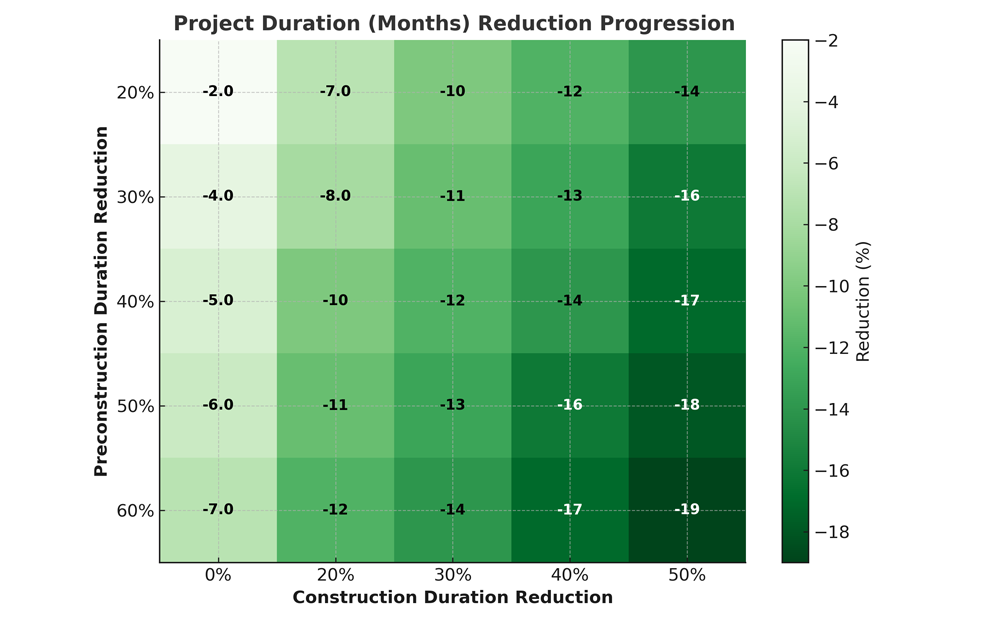
The implications go beyond scheduling. Just as cost data needs systematic collection, so too does schedule data—along with the impact of design and delivery decisions on owners’ and tenants’ ability to occupy and operate.
Time savings have their greatest impact when they translate into value for owners. True transformation of real estate comes from combining the economics of the built environment with the business or purpose it supports—measured primarily by people (human capital) and the business it generates. Upcoming articles on life-cycle analysis and total cost of ownership (TCO) will explore these concepts further.
One way to measure this is to express occupancy value as a percent of design and construction cost per month. In our $50 million project example, each 0.10% per month equals $50,000 in occupancy value; at 1.0%, the value rises to $500,000 per month.
Figure 4 shows how schedule reductions, multiplied by occupancy value per month, translate into operational gains.
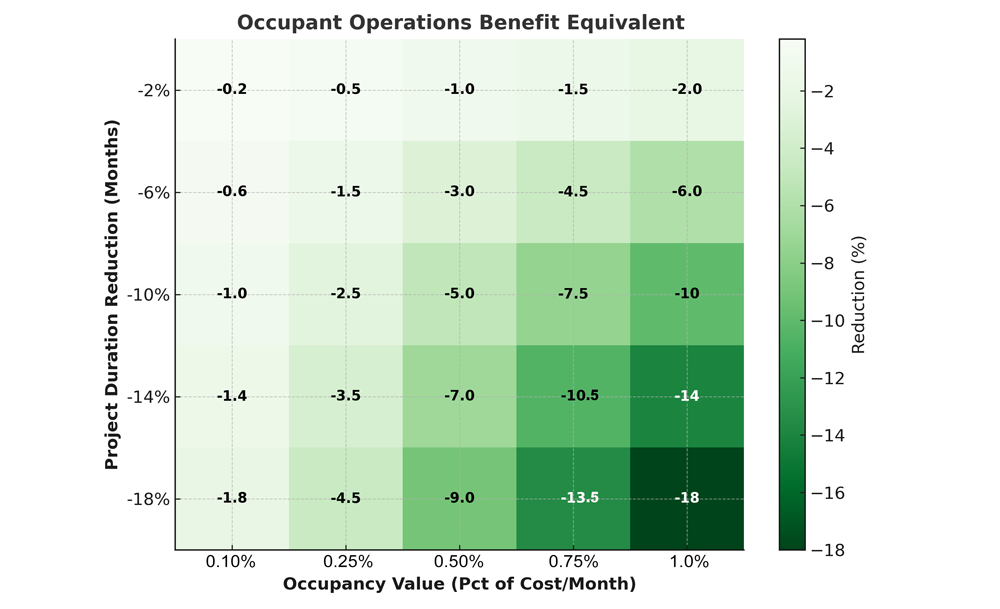
This simple math conveys why a holistic approach is essential. While conceptual, it shows how schedule reductions translate directly into occupancy and operational value—benefits that owners and occupants intuitively understand the importance but have not been able to translate and compare to construction cost. A much more sophisticated data analysis, modeling/simulating and testing process is called for and - through a strong, data-driven Lean 2.0 strategy - will be provided.
IC is not one strategy but many, each with unique trade-offs. Under Lean 2.0, the common thread is to evaluate both first costs and broader value impacts.
Turn-Key, Vertically Integrated Approaches: These first three strategies address fragmentation by providing comprehensive, end-to-end solutions.
These vertically integrated strategies bring scope under a single umbrella, but Lean 2.0 and IAS is still necessary to transform them from partial solutions into pathways for measurable, lasting owner value.
Flexible, Customizable Solutions: These next four strategies allow for selective adoption, giving owners and builders targeted options to reduce labor, shorten schedules, and improve operations. Without Lean 2.0, however, their fragmented implementation risks reintroducing waste and limiting provable value.
Customizable strategies allow owners to scale industrialization incrementally, but Lean 2.0 and IAS ensures that flexibility doesn’t come at the expense of fragmentation or new layers of non-value-added cost.
To illustrate, consider tenant fit-outs. Today, the installed cost of modular interiors—partitions, glass fronts, door assemblies—may be three to four times higher than conventional drywall and framing. Viewed narrowly to direct cost, this looks prohibitive.
But when Lean 2.0 and IAS is applied alongside IC, and especially when the above described occupancy value is factored in, the premium is offset by faster installation, reduced disruption, and greater adaptability. Renovations become far less disruptive, and reconfigurations take days instead of weeks.
As Churchill observed, “We shape our buildings, and then our buildings shape us.” Modular Architecture, measured holistically, ensures buildings can adapt as quickly as the people and businesses within them.
The root cause? The industry suffers from a lack of a true knowledge system. Even the most sophisticated cost consultants and builders’ estimators cannot accurately or reliably predict costs. Instead, they shape the highest possible budgets owners will tolerate—and those inflated budgets then drive excessive costs, as national data confirms and described throughout this series of articles.
A key deterrent to IC adoption is also the lack of competition and impartial comparative analysis of value. Too often, IC producers operate in narrow markets without sufficient benchmarking against conventional methods. This makes it difficult for owners to measure true benefit. Lean 2.0’s market data modeling solves this problem, providing an impartial framework to evaluate IC strategies side by side with traditional approaches.
These Lean 2.0 articles, Applied Data Research and Making Construction Measurable present the means that are essential IC
The Deming-based knowledge system that transformed Toyota can do the same for construction. With Lean 2.0 and IAS:
At Building CATALYST, we are bringing this knowledge system to market. Our approach enables the combination of Lean 2.0 with IC strategies to deliver measurable value for owners, and a greater return on effort for owners’ reps, architects, builders, and IC producers.
The best and surest way to advance IC is through Applied Data Research where the true total value between IC and conventional construction is compared, and from which IC can advance with measurable process improvement studies. Ultimately, total cost of ownership (TCO) and life cycle analysis will be possible. Until then, an initial data research initiative is needed to measure the following:
If you are part of the IC movement and want to see it advance through measurable value improvement please visit us at www.buildingcatalyst.com