

In 2004, the U.S. Bureau of Labor Statistics released a study examining productivity from 1964 to 2003. While manufacturing had improved productivity by 220%, construction had declined by 20%. That same year, the Construction Industry Institute (CII) published Report 191 to help explain why.
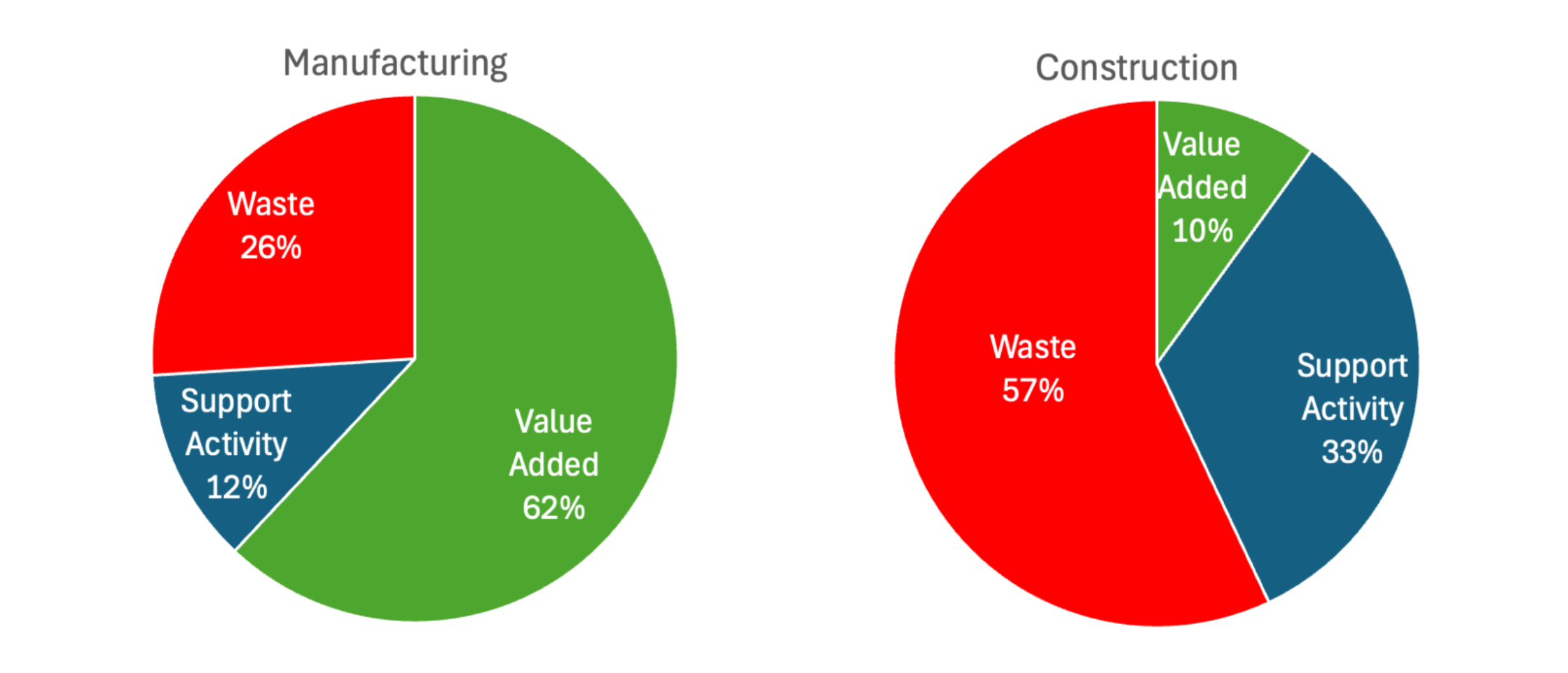
One of its most striking findings: only 10% of construction labor was classified as value-added, compared to 62% in manufacturing, as shown in Figure 1. That means a staggering 90% of construction labor effort was categorized as waste or support activity.
CII’s report aimed to bring lean manufacturing principles—especially the Toyota Production System—into construction. It defined lean construction as:
“The continuous process of eliminating waste, meeting or exceeding all customer requirements, focusing on the entire value stream, and pursuing perfection in the execution of a constructed project.”
Notably, while the report acknowledged waste throughout the entire process, it focused largely on field operations—leaving the more significant aspect of the value stream unexamined. So what happened after this productivity wake-up call?
From the 1960s through 2003, owner building costs rose to 150% (1.5x) above what national inflation would justify, as shown in Figure 2. However, direct work (building materials and field wages) only rose to about 110% (1.1x) above inflation. The gap? The logical conclusion is that it came primarily from indirect labor, overhead, and associated waste and profit.
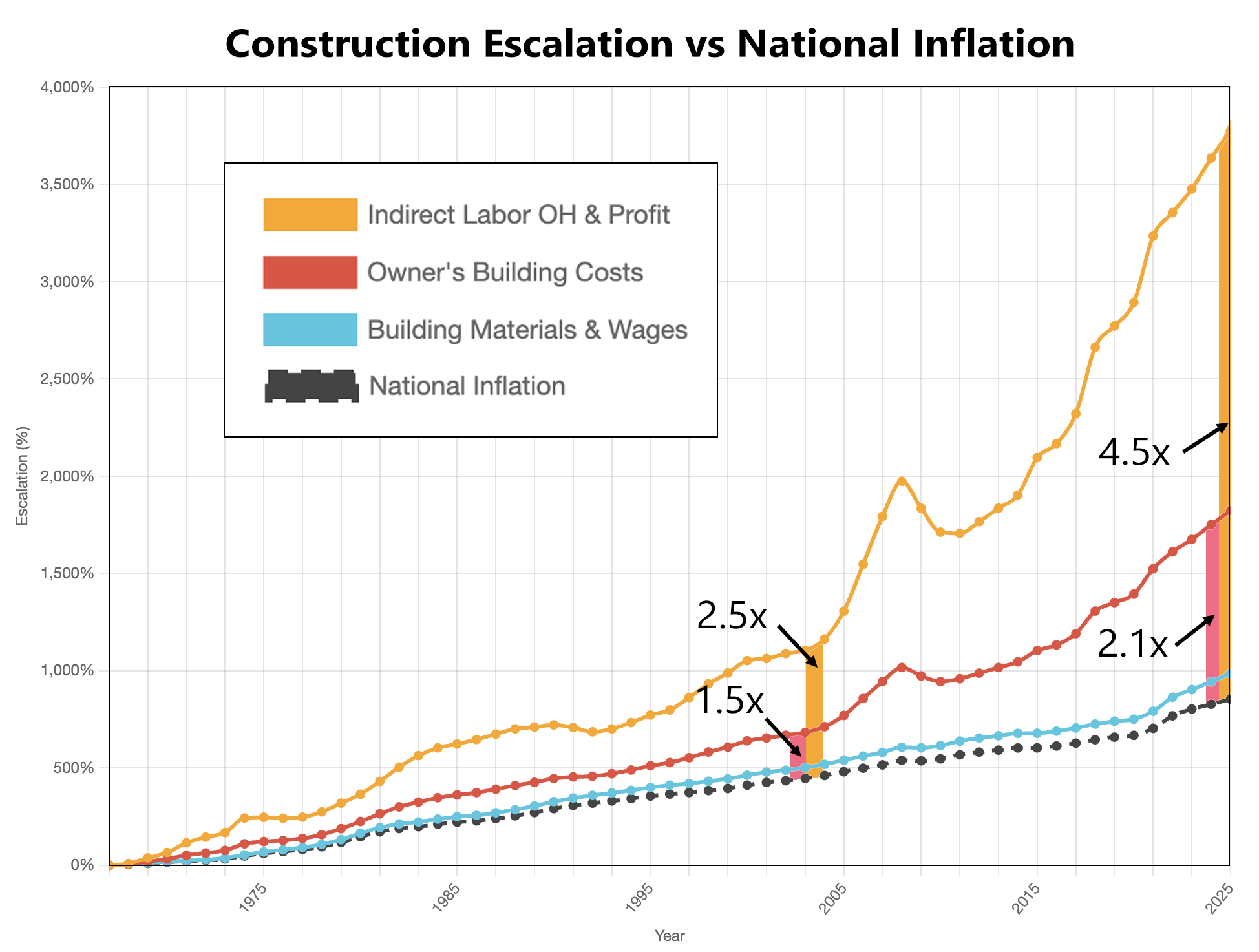
Let’s assume, for simplicity, that an electrician in 2003 pulled wire at about the same rate as his father. And that regulations (i.e., codes), and design quality evolved similarly to manufacturing. From this baseline, a basic comparison shows: non-direct costs grew to 250% above inflation—a 2.5x gap, largely unaccounted for by materials or field labor.
What was considered alarming in 2004 has only gotten worse.
From 1967 to 2003, owner costs grew 22.5% faster than national inflation. Since then—despite the 2009 and 2010 recession—the gap has widened to 65.5%. Even more telling, the indirect cost category (labor, overhead, waste, and embedded profit) grew, as shown in Figure 3:
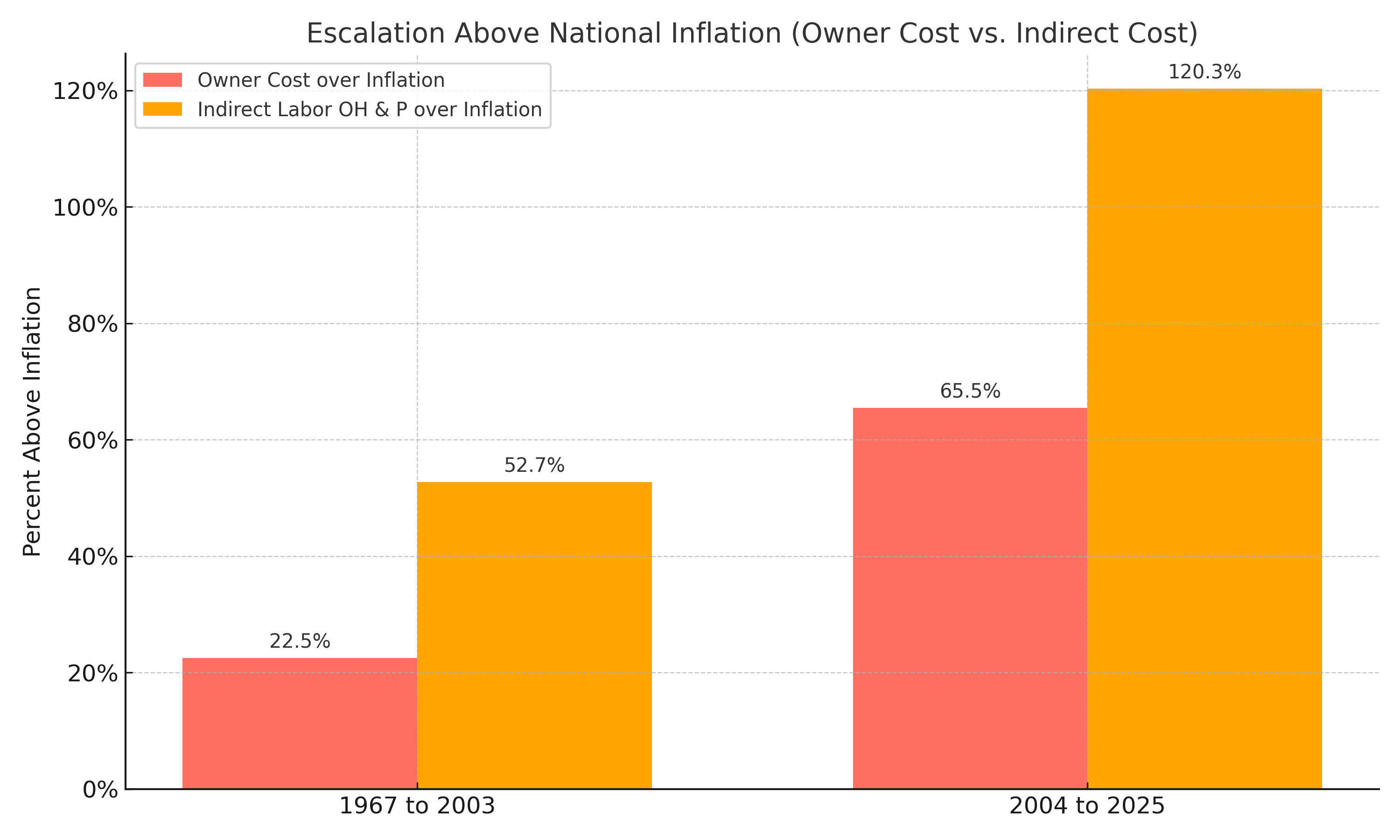
In short, a far greater amount of overhead-driven waste that’s doubled construction costs has been added since the Construction Industry Institute’s 2004 call for lean construction.
With today’s ability to combine macroeconomic data and micro-level project analytics, we can now begin to form, test, and refine hypotheses to diagnose and address the underlying inefficiencies.
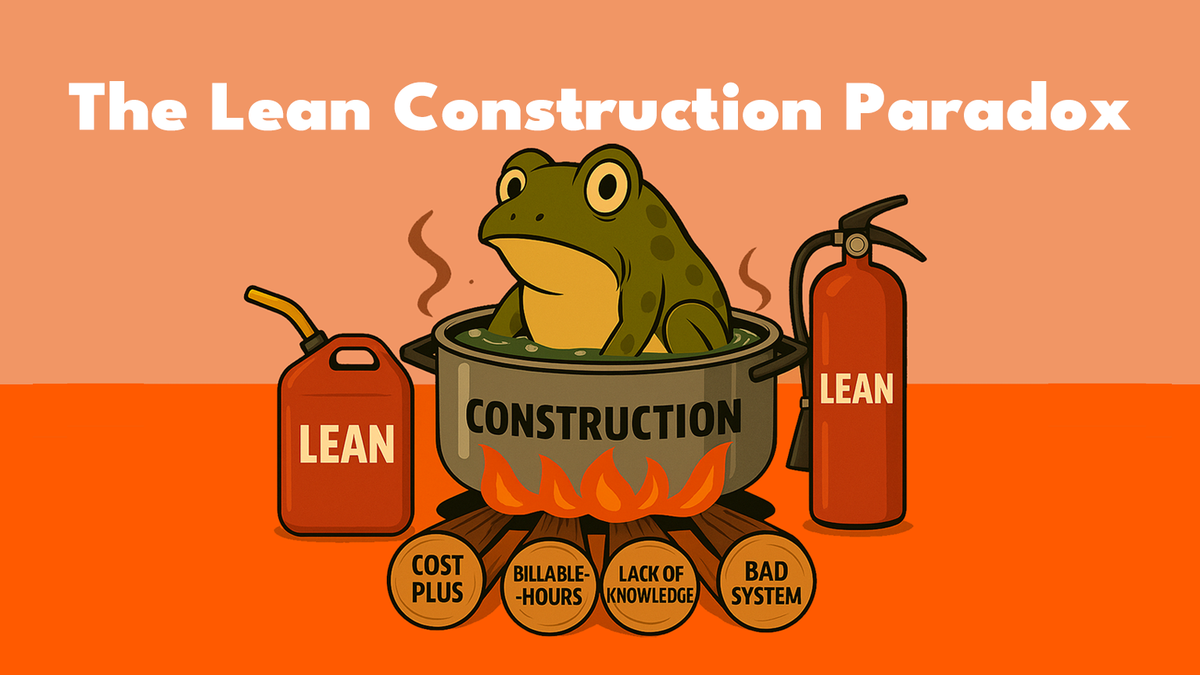
1. Why was construction waste a crisis in 2004—but not today, when it's even worse? The answer may lie in the proverbial “boiling frog” effect—waste has increased so gradually that we’ve stopped noticing. This effect has been given over to a lean paradox: Some would argue that lean gained traction after the 2004 cost surge, to help extinguish the fire. Our data suggests it may have, rather, fueled the fire - by increasing the proportion of negotiated, cost-plus, and billable-hour contracts—structures that misalign incentives and accelerate cost escalation.
2. Why isn’t more research focused on indirect labor and overhead? Again, the data shows the most alarming growth isn’t in field labor inefficiency—it’s in the indirect, overhead side of the equation. The waste is massive across the board, but it's the hidden, nonproductive layers that are expanding out of control.
3. If misaligned incentives are a known problem—as McKinsey and others have argued—why haven’t better compensation models gained traction? No one wants to return to lump-sum, design-bid-build contracts. But the industry still lacks the alternative to truly align incentives across stakeholders.
4. What happens next? It’s time for a coalition—forward-thinking owners, researchers, and AEC professionals—committed to applied research, measurable process improvement and value-based transformation. This is the path to a desperately needed reformation.
Fortunately, we don’t need to start from scratch. The same management philosophy, scientific methods and systems thinking that sparked lean manufacturing can guide us again—this time, to rescue a fragmented and unsustainably costly construction process.
In our next article, we’ll examine the labor component of the cost crisis. Then, our series will turn toward a roadmap for reversing decades of waste—offering a win-win, value-driven, and highly automated alternative to planning, design, and delivery.
Would you like to learn more or even start the self discovery process yourself? Just visit www.buildingcatalyst.com