

Our national debt is currently approaching $37 trillion, or $325,000 per taxpayer. It is a relief to see that there’s finally an interest in circumventing an economic collapse. Of the $7 trillion in annual federal spending, DOGE is targeting $1 trillion in reductions, or 15%.
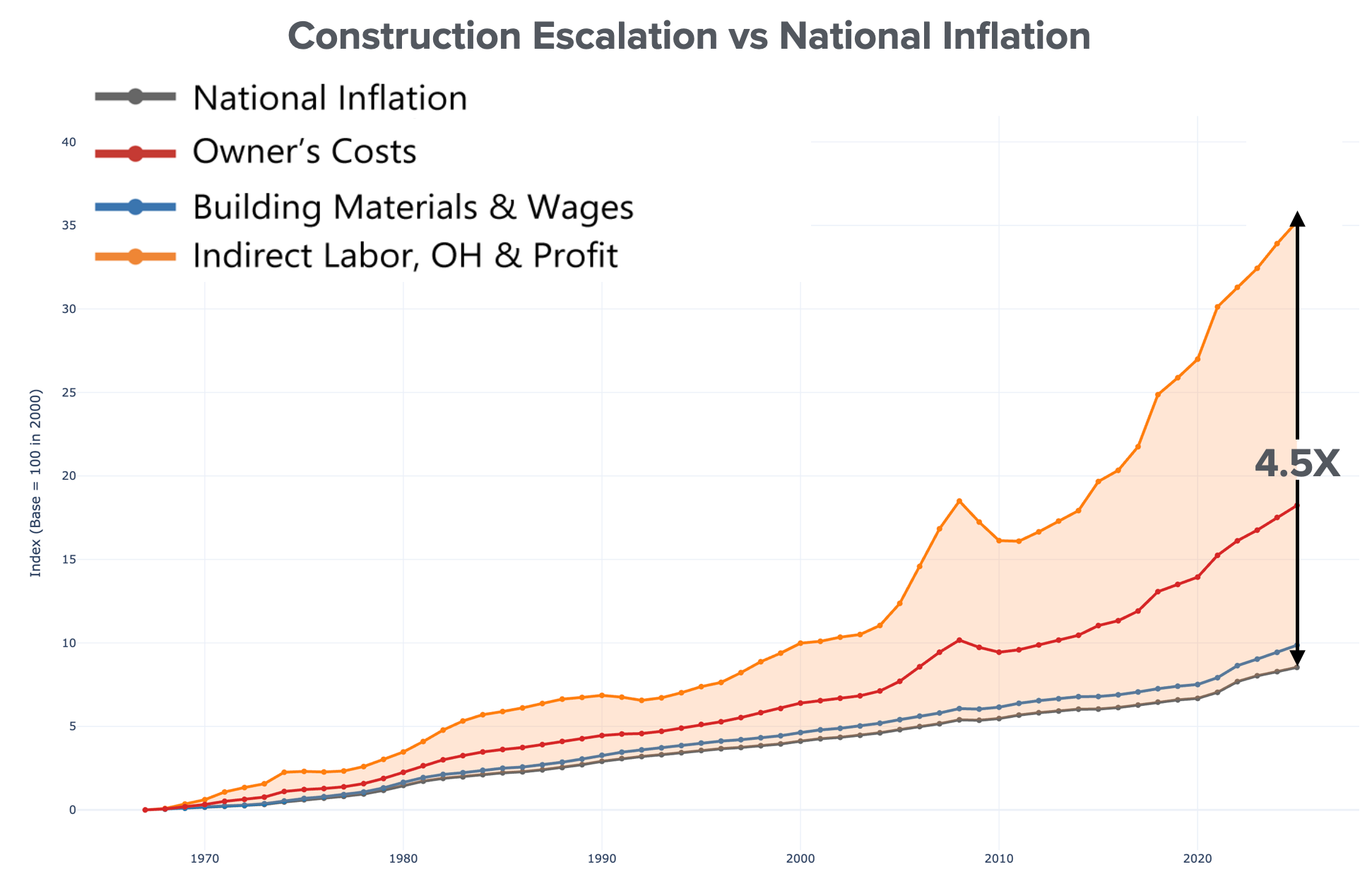
In perspective, this year construction volume will exceed $2 trillion dollars. It should surprise you that half, or $1 trillion, of that is waste – based on what national inflation justifies. Building materials and construction wage rates have only escalated to 14% above national inflation. In a simple math exercise, we can measure the cumulative growth of the non-material, non-direct field labor portions of the project.
Alarmingly, therefore, waste in terms of indirect labor, overhead, overdesign, and embedded profit has skyrocketed to 4.5 times what national inflation justifies. Figure 1 – Construction Escalations vs. National Inflation reveals this hidden, but catastrophic, reality.
Although the data suggests that there’s no end in sight, there is a remedy that can start eliminating layers of waste on most building projects – even those that are currently in the early planning or design stages.
Construction is in an 80-year time warp - so says the McKinsey Global Institute1. Project planning, design, and delivery remains in an archaic, dysfunctional, manual, fragmented, and one-off state. Despite myriads of technology advancements, starting with BIM, there is virtually no effective standardization, integration, or automation within or across owner/developers, owner reps, planners, architects, construction managers/builders, or trade contractors.
Why is this? The answer is so basic.
All construction-related profit is calculated based on cost and/or hours of effort. The higher the budgets, cost, and/or billable hours – the greater the profit. There is no financial incentive for facility managers, owner reps, cost consultants, architects, engineers, builders and increasingly trade contractors “partners” to reduce waste.
Until we flip the profit motive throughout the project life cycle, waste will continue to skyrocket and further cripple the design and production of the built environment.
Thanks to the work of W. Edwards Deming plus advanced forms of data processing, the means now exists to transform facility planning, design, and construction management. Deming’s management philosophy and scientific approach to innovation transformed manufacturing, retail, and other sectors. His philosophy and approach applies to all complex systems – buildings being the most complex of all.
Building CATALYST will enable you to apply the transformational work of Deming to your next project - even one currently in the planning or early design stages. The accumulated waste is so massive that any owner’s rep, designer, or builder can now offer the owner/developers an alternative to improve certainty and reduce cost. And can even start generating a greater return on investment and effort on the first project.
To learn more or start the journey to recovery, visit buildingcatalyst.com.
End Note:
1 - McKinsey Global Institute 2017 Study and Report: Reinventing Construction: A Route to Higher Productivity - Page 4