

The 2025-26 Indiana Hoosiers, led by Curt Cignetti, were transformed from being the most unsuccessful college football program in history to becoming undefeated national champions - in just two years. It was amazing to witness the excellence in execution—a true work of art—as powerhouses like Oregon and Alabama were completely routed.
Imagine, however, if Fernado Mendoza and the rest of the Indiana football team had never met before being assembled at random, and then given only a week to draw up and practice plays before the big game. The same good players playing the same great game, yet producing vastly different outcomes.
Despite decades of efforts to address fragmentation and stagnation, the data reveals a construction industry that continues to perform like a pre-2024 Hoosier team: good people, in a great industry, operating within a bad system.
At its core, that system has two fundamental problems: a lack of objective knowledge and misaligned incentives.
The article, Construction Reform Requires Profound Knowledge presents a fork in the road. One road looks to AI as the principal knowledge resource and change agent for improvement. The other road looks to W. Edwards Deming’s application of the System of Profound Knowledge to solve the fragmentation, knowledge, and incentives problems. It looks to AI as a supporting agent. Based on Deming’s work, Building CATALYST offers a Construction as a System (CaaS) strategy to effectively replace our cacophony of multi-dimensional silos – informational, technical, procedural, and organizational. It also solves our contractual problem that fosters misaligned incentives.
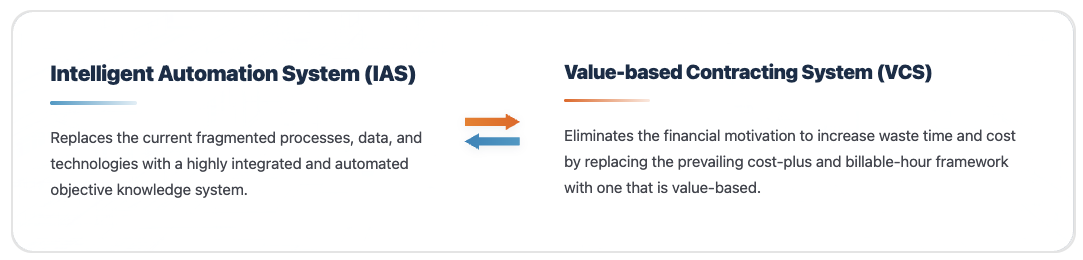
CaaS provides both the engine—the Intelligent Automation System (IAS)—and the fuel—the Value-based Contracting System (VCS)—as illustrated in Figure 1. The IAS provides the means to transform how construction is planned and produced, while the VCS provides the motivation to drive that transformation. Together, they establish the foundation for reforming construction—one project at a time.
Building CATALYST has developed the first Intelligent Automation System (IAS), a groundbreaking approach to building planning, design and delivery that has been applied to more than 800 real-world projects. The IAS demonstrates that, with the right data, building outcomes can be modeled rapidly and reliably—even before a space program or conceptual design has been developed.
The two videos—River Stop Medical Center and Gateway Tower—illustrate the power of profound knowledge in action. Tasks that would traditionally take days or weeks using conventional processes and technologies can be performed by CATALYST in real time.
This is the promise of Intelligent Automation: transforming deep building knowledge and data into immediate, actionable insight—accelerating decisions, reducing uncertainty, and fundamentally changing how buildings are conceived and delivered.
From the earliest planning stages through schematic design and an approved budget—or target value—CATALYST brings intelligent automation to the dozens of critical decision cycles that shape a project. What traditionally takes weeks or months can be compressed to hours or days. The implications are profound: dramatically greater efficiency, faster iteration, and a level of execution excellence that is beyond imagination.
As remarkable as this is, it is only a glimpse of its full potential. As described in Why Hospitals are in a Construction Cost Crisis, the non-value-added scope and waste associated with a single hospital can amount to several hundred million dollars. The value-added scope—materials and direct labor—represents only a small fraction of what owners ultimately pay for hospitals. We now have the potential to reduce the non-value-added scope by tens, if not hundreds, of millions of dollars on a single hospital project.
Technically, we can readily reform construction processes to eliminate multiple layers of waste, particularly in non-value-added activities and costs.
Contractually and motivationally, there is currently no financial incentive to adopt an Intelligent Automation System.
That’s why the Value-based Contracting System (VCS)—the fuel that powers change—is essential to realizing the CaaS vision.
At the heart of Dr. Deming’s management philosophy is the pursuit of a win-win outcome for every member of the team. Achieving that outcome, however, requires a fundamental rethinking—and, essentially, a reversal—of the misaligned incentive structures deeply embedded in today’s consulting, design, and construction contracts.
The misaligned-incentive problem is rooted in two primary profit frameworks: cost-based (cost-plus) models and billable-hour compensation models. Both frameworks reward activity, cost, and hours rather than the creation of measurable value.
As a result, individual and organizational incentives become aligned around maximizing effort, scope, and billings—not around improving outcomes for the owner. The fundamental issue is that revenue and compensation become tied to inputs and activity rather than results and value created.
Dr. Deming’s system demands the opposite: incentives that align everyone around shared objectives—continuous, measurable improvement; quality; productivity; and project value. When the team members who design, manage, and deliver the work benefit from eliminating waste and increasing value—not from generating more hours or driving up costs—the economic interests of the owner and its team members can finally converge. The goal is to align external financial incentives with internal, intrinsic motivation, creating a system in which the team is rewarded for doing excellent work, improving the system, and delivering greater value—not for creating more work or higher costs.
Another important point relates to risk aversion. The combination of risk aversion and uncertainty caused by lack of knowledge is dangerous and a major factor in the skyrocketing hospital costs. Once the lack of knowledge problem is solved, the entire risk/reward framework can be corrected.
Dr. Deming’s System of Profound Knowledge, translated into the Intelligent Automation System (IAS), provides the objective, data-driven market valuation and risk analysis necessary to replace traditional cost- and hour-based compensation with a Value-based Contracting System (VCS). By evaluating value, performance, variation, and risk systematically, the IAS establishes a more impartial foundation for determining compensation based on measurable outcomes rather than time expended..
The resulting Construction as a System (CaaS = IAS + VCS) enables Hoosier-like rapid turnaround—even for projects currently in planning or early design.
There are multiple use cases for piloting and implementing CaaS, depending on the project’s current status and the composition of the project team.
For example, consider a hospital project that is currently in the planning and early design phases and has been selected to launch a construction reform initiative. At this stage, CaaS can be introduced as a structured framework to align the owner and team around new ways of working.
This early-stage hospital project provides a strong environment to pilot and test CaaS for two reasons. First, the extraordinary surge in hospital construction cost since 2018 can now be submitted to IAS for cause-and-effect assessment. Second, the team still has meaningful opportunities to influence project scope/design, contracting/delivery methods, and process improvement strategies before those choices become difficult or costly to change.
Let’s consider this use case composition:
Building CATALYST provides two straightforward steps to determine whether to proceed with implementing CaaS on this project:
Building CATALYST will provide, free of charge, multiple data models (sets) and comparative analyses based on the information provided. The analysis will compare, in detail, the project’s space program, site and building scope, and budget against market-average baseline and one or more relevant benchmarks.
The analysis will provide a range of project scope and CaaS improvement options, including targets for total real value added, owner Return on Investment (ROI), and team Return on Effort (ROE).
Finally, CATALYST will develop a recommended pilot scope and investment proposal, outlining the path forward.
Building CATALYST will lead a series of workshops designed to take the project scope and budget analysis to a deeper level. We will also run multiple “what if” simulations to demonstrate value-added through automation, waste reduction, and other measurable process improvement strategies. The simulations will quantify a range of real value, owner ROI, and team ROE, providing a clear, data-driven view of the potential impact of each improvement strategy.
Finally, CATALYST will also prepare and present a comprehensive CaaS implementation plan and Value-based Contracting (VCS) framework proposal. The plan will include a matrix comparing the scope and budget prior to the pilot initiative, together with the acceptable options from the workshops.
The measurable outputs are intended to answer these questions:
The implementation proposal will provide a matrix process and value improvement potentials and other insights about the project. The owner and team can then decide to proceed with the Building CATALYST CaaS proposal, or use the information and insights to develop an alternative process and value improvement implementation strategy and implementation plan.
Again, there are other use cases that may range from projects in the earliest stages of feasibility studies to those where schematic design has been completed and a GMP or TVD budget has been established.
The choice regarding the pilot should be an easy one for owners. On one hand, there is no downside, cost, or risk associated with the Step 1 Free Project Analysis. On the other hand, there is a real opportunity to eliminate tens of millions of dollars in non-value-added scope and cost.
And that’s not all. Successful implementation could provide the launching platform for a desperately needed construction reform movement—one capable of improving how projects are planned, designed, procured, and delivered.
However easy the choice may seem for owners, it will likely be met with stiff resistance from consultants, designers, and builders. Tampering with cost structures and billable-hour-based compensation threatens the established sources of profit across the board. This reality puts willing owners in a quandary. While there may be little to lose, realizing the substantial potential gains requires a team willing to reconsider the financial calculations that drive how they make money. That is no small roadblock to overcome—regardless of how committed the owner may be to Deming-style, win-win business strategies.
We believe that overcoming this roadblock requires solutions that transcend the limitations of every human attempt to address construction’s fragmented and stagnated state - from CM starting in the 1970s to the more recent lean IPD methods.
As noted above, some efforts to improve construction will look to the transcendent capabilities of AI as a primary source of knowledge and as a principal agent for change. This represents the first road to the future.
Building CATALYST has developed a second road: a Construction as a System (CaaS) alternative that integrates the complexity of data science with Deming’s management philosophy, profound knowledge, and systems thinking. In this approach, the philosophical and transcendental dimensions are grounded in ancient wisdom and a Christian worldview1. In essence, the owner and each team member must sacrifice the optimization of their own involvement in the project, in order to optimize the whole. This may appear to be a bird-in-the-hand vs. two-in-the-bush, a consideration that is too hard to make.
The battle of the mind is a battle between two competing worldviews: one that is siloed, self-centered, and confined to the here-and-now temporal reality, and another that is biblically grounded—holistic, shaped by the tension of the “already and not yet,” and centered on the interests of others and the whole body (system).
Deming put it this way, “What we need to do is learn to work in the system…that everybody, every team, every platform, every division, every component is there not for individual…profit… but for contribution to the system as a whole on a win-win basis.”
For owners and their teams for whom this rings true, the second road—Construction as a System—is well worth exploring. It offers the kind of transformation that many enjoyed watching over the course of the Hoosiers’ storied season.
Just visit www.buildingcatalyst.com to learn more.