

Someday—hopefully soon—we’ll look back and recognize the madness of cost-plus and billable-hour contracting in planning, design, and construction. Both serve as profit sources, but billable hours, in particular, have created artificial demand—driving a system where people are incentivized to generate work simply to fill time. Despite decades of innovation, including BIM and a lean movement focused on eliminating waste, today’s projects are more heavily staffed than ever—often with people creating work for each other.
Because pricing is governed by supply and demand—and billable hours artificially inflate demand for labor—owners, as the buyers, are hit with a double whammy. They're trapped in a perpetual, artificial seller’s market—driven by more billable hours than necessary, which inflate demand for unnecessary labor and drive up costs.
The compounding effect should be hard to miss. Higher budgets, inflated by unnecessary billable hour costs, drive up trade costs—together forming the basis for construction service fees. And because those fees are calculated as a percentage of total cost, they appear reasonable—even though the cost basis itself is artificially high.
And to make matters worse, we now face a shortage of skilled labor at nearly every level. Buildings today cost nearly twice what they should—and it has little to do with the actual work of construction: materials and field labor.
Unless today’s electrician pulls less wire than his father or grandfather, we can assume that direct labor productivity has held relatively steady. That means direct costs—materials and skilled labor—have only modestly increased, rising just slightly above inflation
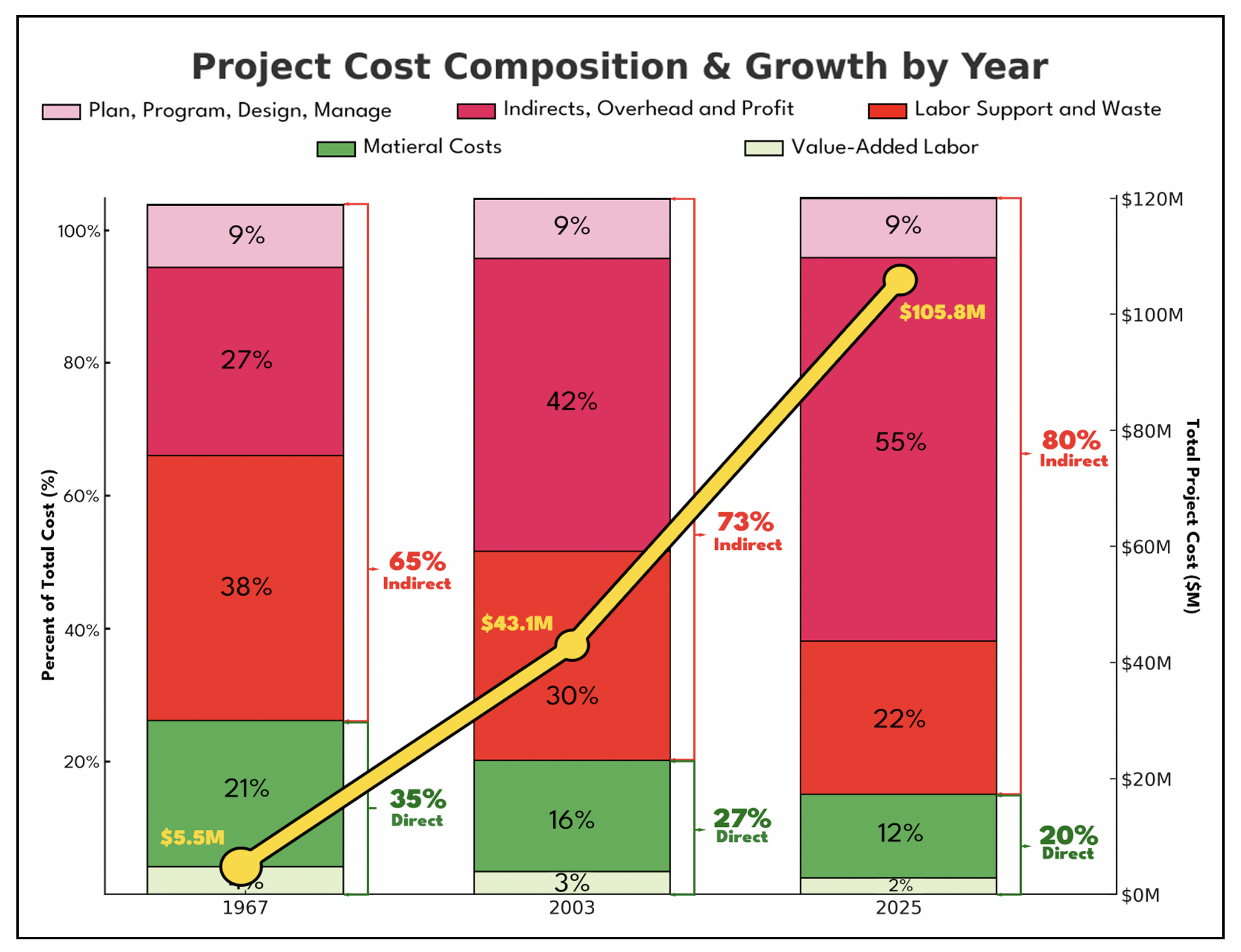
So where is the cost coming from? A simple math exercise reveals the answer: indirect, overhead-driven costs have more than quadrupled.¹
By looking both backward and forward, we can use simulation models—grounded in the 2004 Construction Industry Institute (CII) Report 191 and long-term construction escalation data—to uncover critical insights.²
CII Report 191 found that only 10% of construction labor was value-added before 2004. In other words, 90% was classified as supporting effort or waste. If we accept that: If we accept that (1) the CII study is accurate, (2), the earlier wire-pulling productivity assumption holds across trades, (3) just 10% of total project cost accounts for planning, design, and program management, and (4) the macroeconomic trends presented in earlier articles are valid.¹ ²
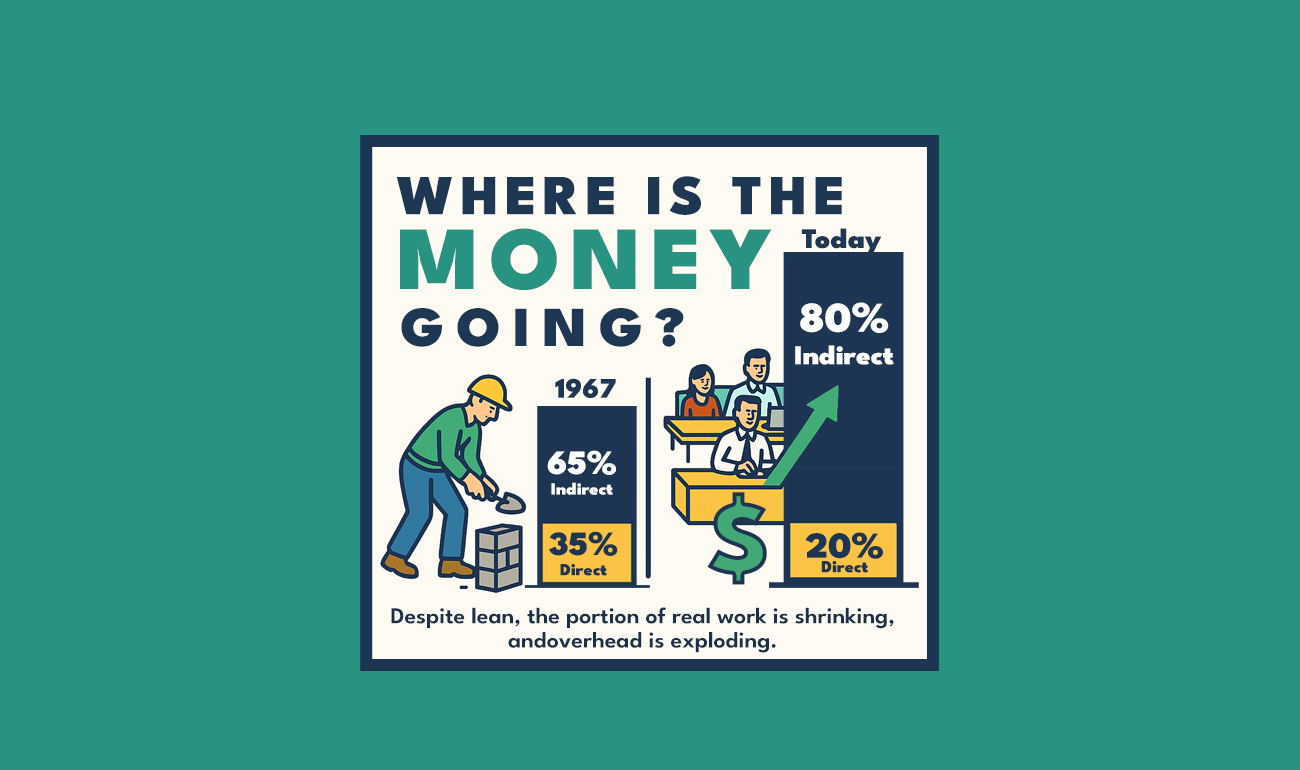
Then, as shown in Figure 1, we see a stark shift: from 1967 to today, the portion of cost tied to actual construction work has dropped from 35% to 20%, while the share consumed by supporting, indirect, and overhead costs has grown from 65% to 80%.
Let’s review. Construction Management (CM) emerged in the early 1970s as a response to persistent failures—blown budgets and missed schedules driven by poor productivity and lack of effective data resources. Other innovations, like Partnering and Total Quality Management (TQM), were explored intermittently through the turn of the millennium.
Three decades into the CM era—during which cost-plus and billable-hour compensation structures became widespread—the CII’s Report 191 delivered a stark assessment: construction productivity had stagnated, especially when compared to manufacturing. The report called for a lean construction movement as the solution.
This is the sixth article in our series highlighting construction’s ongoing failure to resolve its productivity and cost crisis. No innovation—whether CM, lean, IPD, prefabrication, or trade partnering—has succeeded in overcoming the gravitational pull of misaligned incentives built into cost-plus and billable-hour structures.
The result?
Today, 80% of what owners pay for buildings goes to indirects, overhead, and waste—both in time and in cost.
The solution is surprisingly straightforward: a common-sense, well-developed alternative grounded in a proven, win-win management philosophy.
This series now pivots toward that philosophy—along with a clear roadmap to transform planning, design, and construction management.
It begins with data: Looking backward to understand the root causes, And forward to apply new methods—starting with a win-win performance-based alternative to cost-plus and billable-hour compensation, modeled after the successful transformation of manufacturing.
Want to learn more or start your own discovery process? Visit www.buildingcatalyst.com
See article: Construction’s Cost Crisis – An Analytical Overview
See article: Lean Construction’s Relationship to the Construction Cost Crisis