

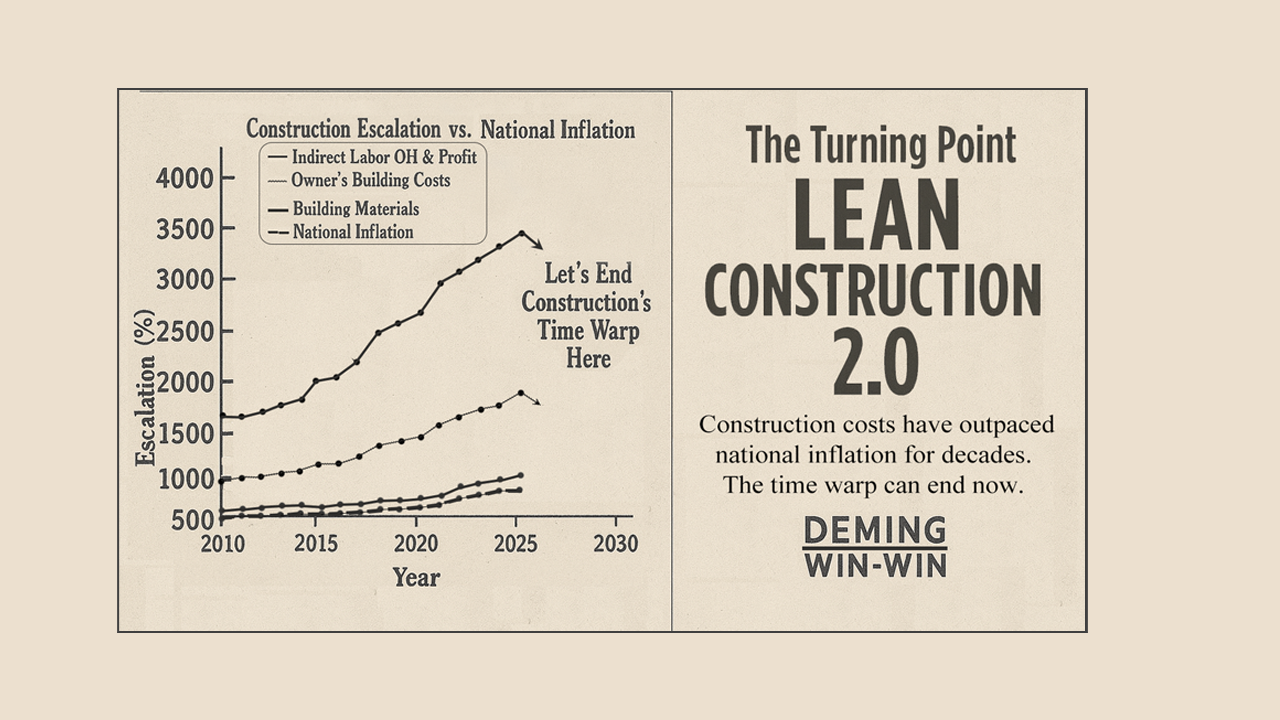
After decades of soaring costs and stagnant productivity, the construction industry stands at a turning point. McKinsey’s 2017 report Reinventing Construction: A Route to Higher Productivity warned of several crippling causes - chief among them are misaligned incentives and fragmentation.
As building costs and overhead have continued to surge far beyond inflation since 2017, a path forward is emerging—one that combines the strengths of lean construction with a proven knowledge system rooted in Deming’s management philosophy. This fusion sets the stage for the measurable ways and means to achieve McKinsey’s call to reinvent construction.
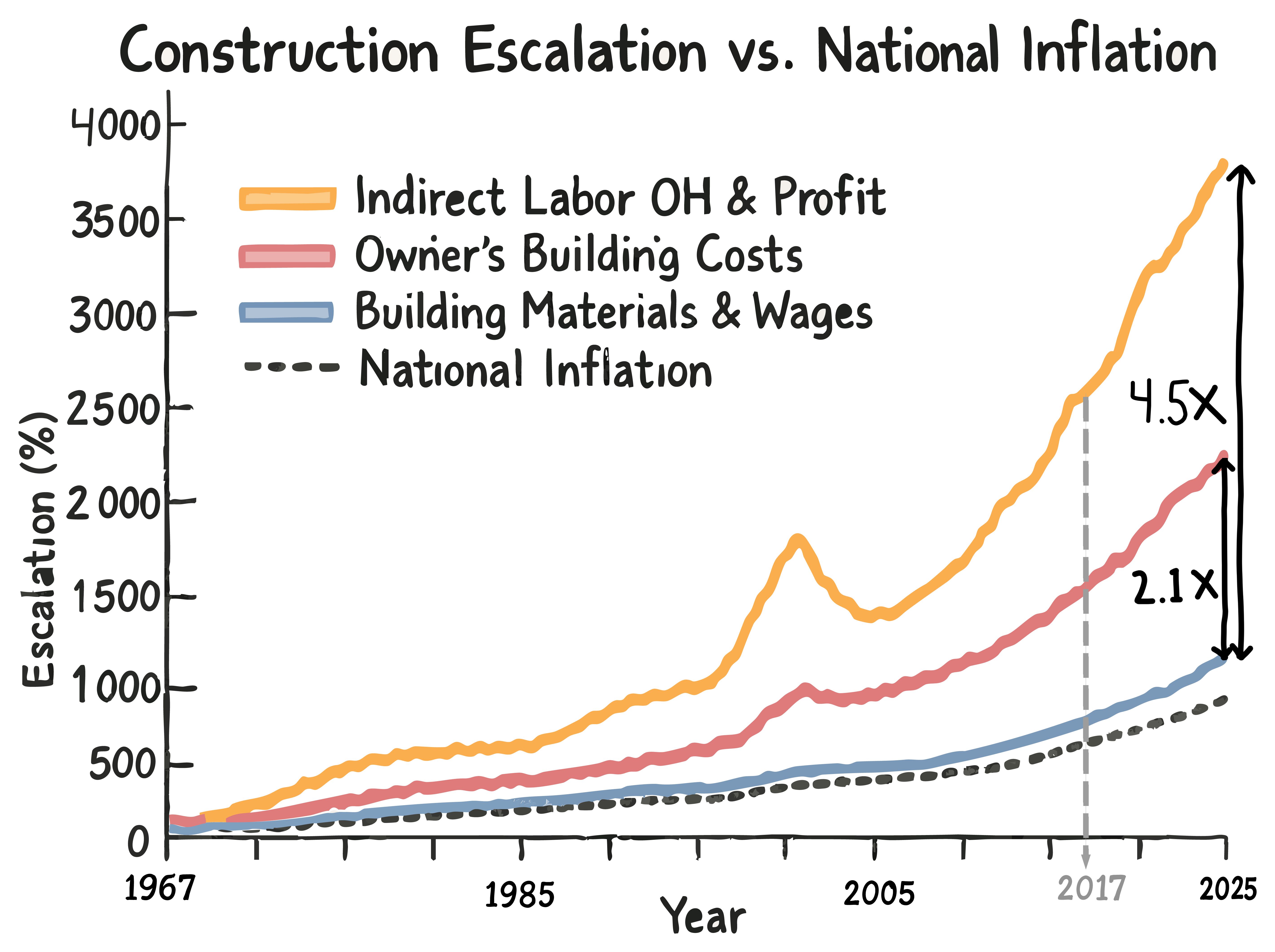
The Lean Construction Institute (LCI), founded in 1997 by Glenn Ballard and Greg Howell, drew inspiration from the Toyota Production System and lean manufacturing principles to advance production system design and management in construction. As described by Dave Umstot and Dan Fauchier in Lean Project Delivery: Building Championship Project Teams, lean principles and practices have gained widespread adoption—largely with the aim of reducing waste and improving efficiency. Yet, as Figure 1 illustrates, construction costs have continued to rise far beyond inflation - primarily due to skyrocketing indirect labor, general conditions and requirements, overhead and associated profit. This raises a critical and timely question:
Why hasn’t lean, despite its broad adoption, curbed the very cost growth it was meant to address?
One reason is the lack of a system - causing these practices and their supporting (disparate, one-off) tools to be layered on top of—rather than replacing—a dysfunctional mix of unstructured information and fragmented processes. Another reason is that the critical principles championed by W. Edwards Deming, which helped transform manufacturing worldwide, have yet to be meaningfully applied to construction. Deming once remarked, “American management thinks that they can just copy from Japan. But they don’t know what to copy.”
Fortunately, the turning point and path forward is becoming clearer. To fulfill lean construction’s promise, we must go beyond tools and terminology and replace outdated systems with an integrated, knowledge-based framework rooted in Deming’s philosophy—a framework that has already proven transformative in other complex industries.
A Deming-based, Lean Construction 2.0 movement can eliminate waste, reduce owner costs, deliver higher-performance buildings, improve return-on-effort, and alleviate crippling debt. This transformation begins with six vital shifts:
1. Win-Win, Value-Based Planning, Design, and Construction Approach
Deming emphasized win-win relationships—those aligned not only with financial outcomes but also with intrinsic motivation and shared purpose.
TO FULLY REALIZE THIS POTENTIAL IN CONSTRUCTION, THE PRACTICE OF CALCULATING FEES BASED ON CONSTRUCTION COST AND/OR BILLABLE HOURS MUST GIVE WAY TO VALUE-BASED COMPENSATION.
Target Value Delivery (TVD), when grounded in impartial, market-based data, aligns well with Deming’s vision. While designers and builders should help define target values, they should not be the ones setting them when a credible and impartial valuation approach exists. A Deming-based knowledge system empowers owner advocates to determine fair value and track key metrics. And with today’s inflated market baselines, the opportunity to increase profitability through time and cost efficiency has never been greater.
2. Consensus Data Structures and Standards
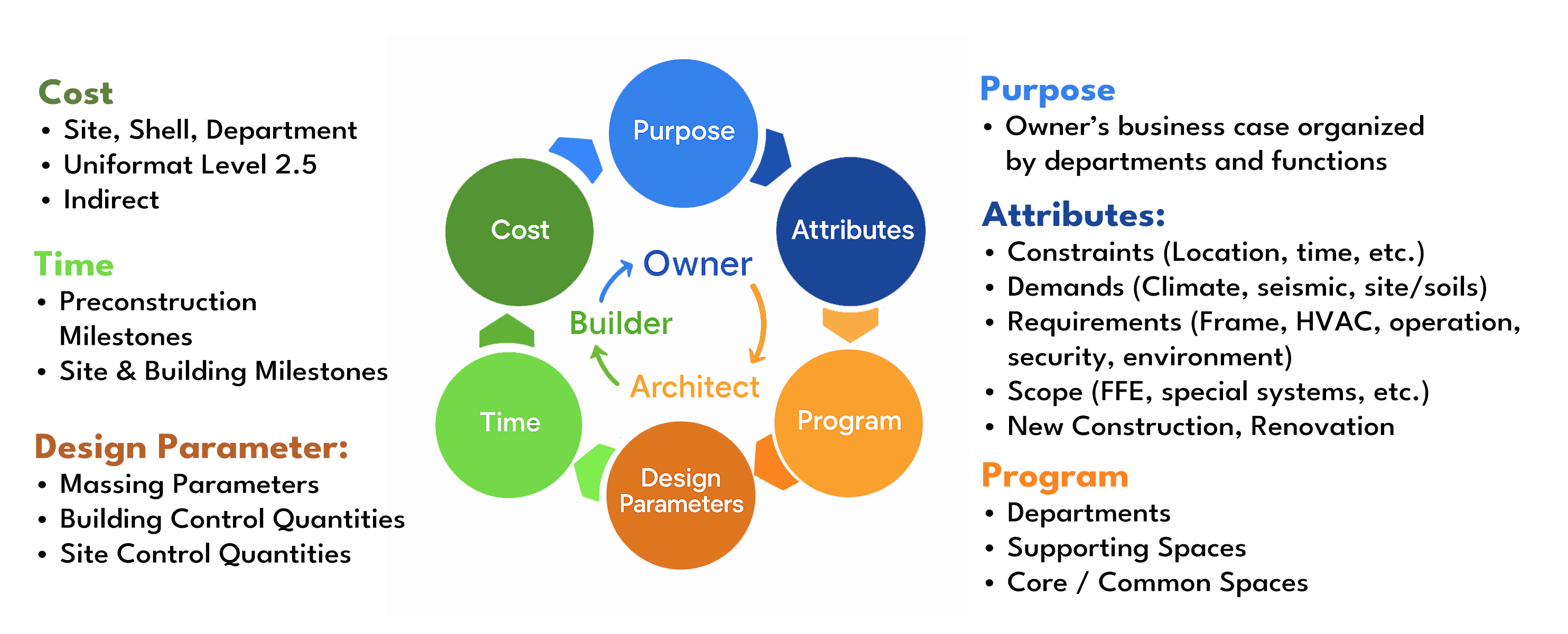
Construction’s “80-year time warp” stems from increasing specialization and hence fragmentation of the design and construction supply chain and a lack of data structures and standards. Efforts like the Construction Specifications Institute (CSI) and ASTM International’s Uniformat Construction Standard have fallen short, with errors, omissions, and inconsistencies revealed in a survey of several ENR Top 100 builders1. Beyond cost, other standards must address the building’s purpose, occupancy functions, spaces, attributes (requirements and constraints), parameters (control quantities), and schedule (production). With the right framework in place, construction can solve the fragmentation problem and finally achieve lasting systemic improvement.
3. Applied Microeconomic Data Research
As highlighted by Figure 1, macroeconomic data reveals disproportionate growth in indirect and overhead costs. To reverse this trend, comprehensive, impartial, and ongoing microeconomic data research is needed, guided by Deming’s Plan-Do-Study-Act (PDSA) cycle. Two approaches are proposed: a backward-looking analysis of completed and ongoing projects to assess current practices, and a forward-looking analysis of proposed projects to evaluate value-driven attributes. This requires recording and analyzing dozens of cause-and-effect data entities—to diagnose the causes of excessive cost escalation and develop solutions.
The macroeconomic data does not reveal other outcomes - especially things like time to deliver, building (energy and operational) performance, disputes, and so on. More comprehensive microeconomic data research should include these.
4. A Holistic BIM Vision
Building Information Modeling (BIM) is defined as “a digital representation of physical and functional characteristics of a facility,” serving as a “shared knowledge resource for reliable decision-making throughout its lifecycle.” Integrating BIM’s digital representation (i.e., Autodesk Revit) with a Deming-based knowledge system (i.e., Building Catalyst) creates a super-lean process for planning, design, and construction management. Successful proof-of-concept pilots demonstrate the potential of combining knowledge-based and digital design-based BIM applications.
5. Measurable Continuous Improvement
Measurable process and value improvement - based on empirical cause-and-effect analysis - is essential, but is nowhere to be found in today’s lean construction practices.. The proposed data research will guide major shifts, such as replacing cost-plus and billable-hour compensation, and provide insights into TVD, Last Planner System, Virtual Design and Construction (VDC), trade partnering, and prefabrication. This PDSA-enabled research lays the groundwork for a robust, continuous improvement process - one capable of driving real change across every stage of planning, design, and delivery.
6. Applied Machine Learning (ML) and Artificial Intelligence (AI)
AI’s potential in construction is severely limited by siloed data. As Deming warned, optimizing parts (silos) harms the whole system—a trend evident in construction’s rising costs. A comprehensive knowledge system, informed by data research, enables ML and AI to access contextualized or networked information, enhancing planning, design, and management of complex buildings. Without this, AI risks exacerbating uncertainty and inefficiency.
A Lean Construction and Deming Collaboration Opportunity
With the Deming system of knowledge - as described in The Power of Knowledge to Reinvent Construction - together we can achieve the Ballard, Howell, and McKinsey vision for a high production, high performance construction industry.
If these ideas resonate, we propose a collaboration to integrate lean practices with Deming’s philosophy and scientific methods to acquire knowledge, ushering in a new era of measurable improvement and innovation.
To learn more about applying Deming’s principles to construction, visit www.buildingcatalyst.com.
End Note: