

So far in this series, we’ve revealed the data that shows buildings now cost owners twice what they should (Construction's Economic Crisis: An Analytical Overview) Why? Because overhead (and other indirect, non-productive effort) has grown to more than four times what it should be.
This explosion in waste stems from an 80-year time warp (as McKinsey puts it) that’s kept planning, design, and construction fragmented and dysfunctional—making measurable process or value improvement nearly impossible.
We’re now more than 50 years into efforts to solve the field productivity problem. The results? Disastrous. There’s still no empirical evidence of value created at the point of production. Meanwhile, the overhead spent trying to create value keeps skyrocketing.
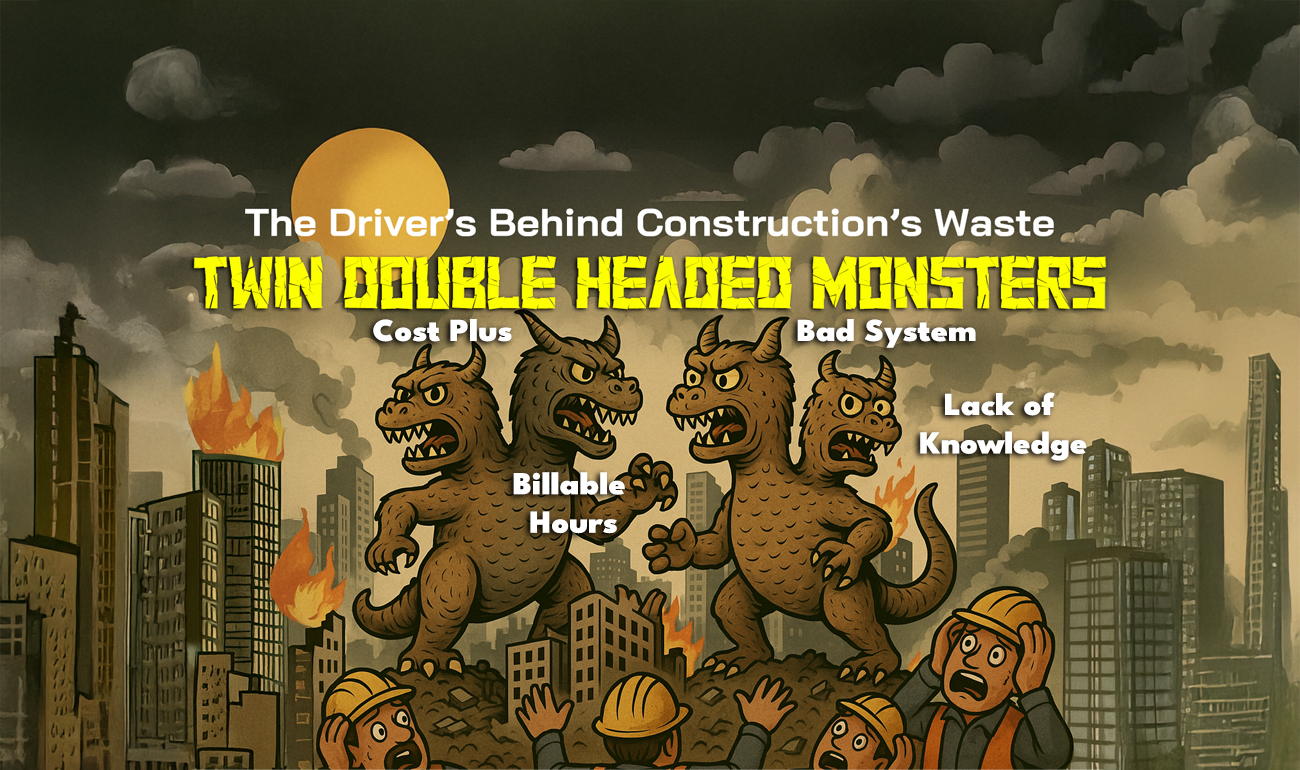
It’s time we turn our attention to two double-headed monsters that must be slain.
Misaligned incentives, though well known, remain largely unchallenged as its two heads, Cost-plus and Billable-hour compensation, continue to dominate the building construction sector.
These emerged with Construction Management (CM) in the 1970s and have only grown in proportion. Today, owners’ reps, designers, and builders are all financially incentivized to shape the highest possible budget the owner can tolerate—and then spend every dollar, especially when billing by the hour.
As CM and negotiated delivery methods (including IPD and Design/Build) have expanded, so too have the billable hours.
The macro-economic impact is staggering, as shown below:
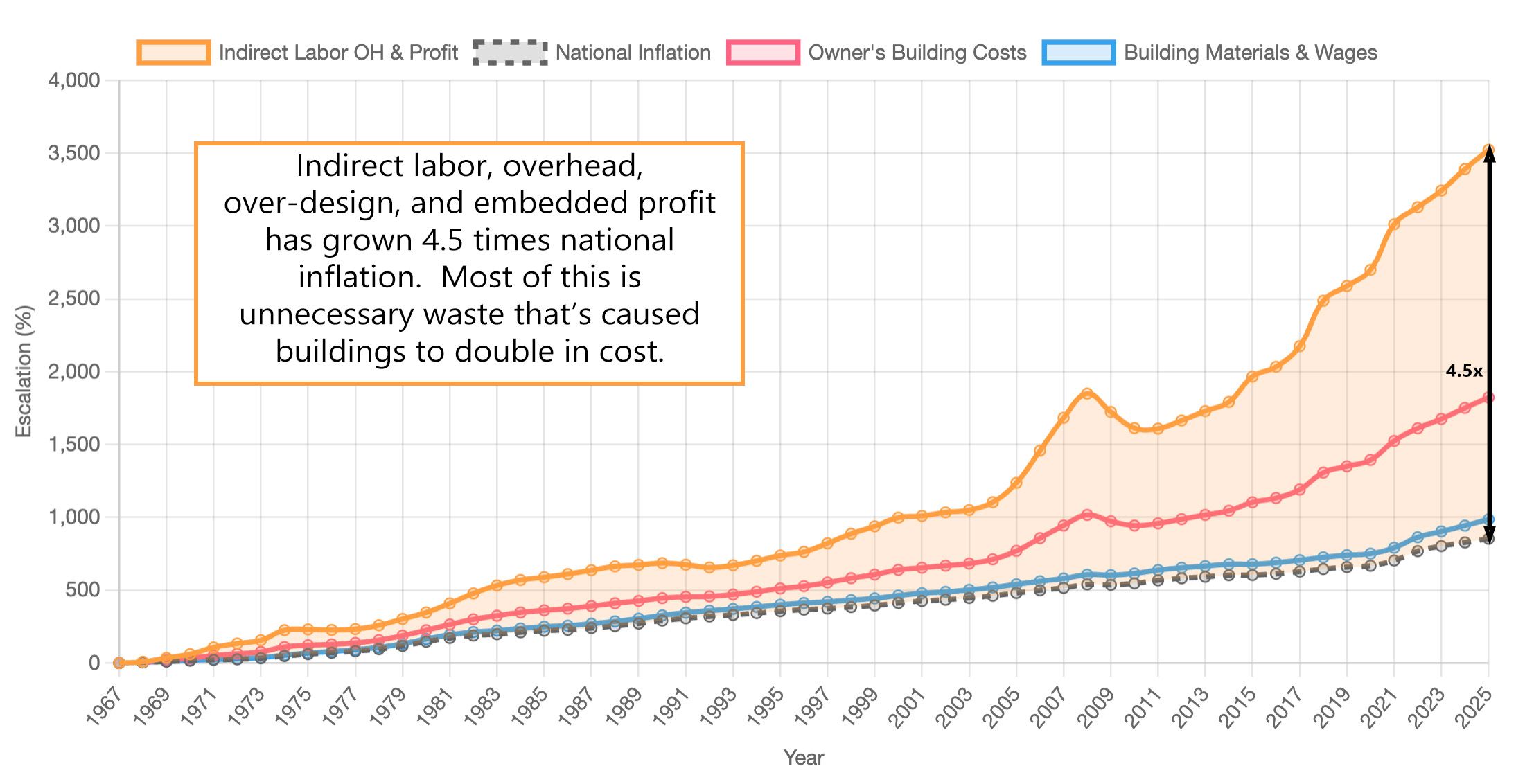
This trajectory won’t reverse until compensation flips—from cost and time-based to value-based. But doing that requires a way to measure value accurately and impartially—starting with an objective analysis of a project’s purpose and functions.
As Deming said, “Lack of knowledge—that is the problem.” He also warned, “A bad system beats a good man every time.” The second monster’s heads are a Lack of Knowledge and Bad Systems.
Even the best cost consultants and builders—armed with decades of experience—still can’t accurately or impartially predict construction costs. Why? Because they’ve never been able to structure and analyze actual results based on the true causes that drive outcomes.
The primary cause is the owner’s business case, translated into functional components (e.g., CT Scan) organized by department (e.g., Radiology). Secondary causes include a broad range of attributes such as owner, location, site conditions, and other project requirements.
Accurate prediction and analysis demand an objective knowledge system of cause and effect. Such a system requires consensus data standards, a processor built on complexity science, and widespread compliance. No single cost consultant or builder can establish this alone, so the fault isn’t theirs.
To help, CSI (Uniformat 2010) and ASTM (E1557 – Uniformat II) have published data standards. But these standards are replete with errors, omissions and conflicts—as confirmed by recent surveys of ENR Top 100 builders.
Fortunately, most of these issues could be resolved through a credible, multi-disciplinary collaboration across the AEC (architecture, engineering, construction) spectrum that could standardize these frameworks. However, builders, being downstream from causal sources, are unlikely to lead this effort.
People are intrinsically motivated to deliver excellence, make smart decisions, and solve real problems. But across the PDC (planning, design, construction) lifecycle, there is no financial motivation for their employers to improve process or value in measurable ways.
Waste continues to pile up—not because people are careless—but because it’s profitable under current contracting structures. Owners pay the price. This current win-lose compensation framework must, and can, be replaced with a win-win, value-driven approach.
In the next post, we’ll examine the relationships between BIM, Lean, and the construction cost crisis.