

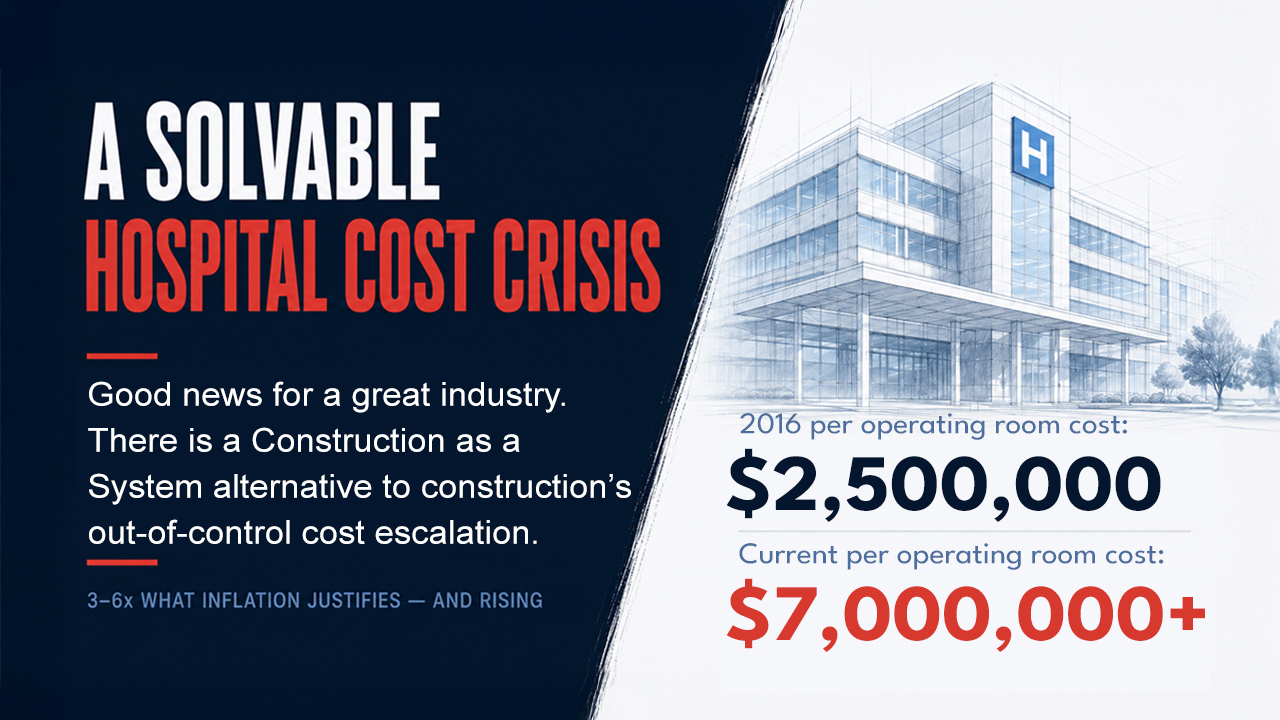
Construction’s long, steady decline in productivity and value took a far greater turn for the worse starting around 2018. Based on a 35-hospital data research study1 completed in April, healthcare owners are now paying tens to hundreds of millions of dollars in unnecessary, non-value-added costs per hospital.
To help put the magnitude of this problem in perspective, consider the example of a hospital operating room. Based on national inflation2, the construction (hard) cost for each OR should amount to about $2 million (including apportionment of supporting spaces, core, shell, site, and indirect costs).
If we applied Construction Analytics’3 tracking of construction escalation, the same OR being planned today would be budgeted at roughly $4.4 million—more than double the inflation-adjusted value. However, as seen in Figure 1, an inexplicable circa-2018 surge has caused that OR to cost owners between $6 million and over $9 million (normalized to a mid-market like St. Louis). Even worse, it could cost between $11 and $14 million if located in highly regulated California.
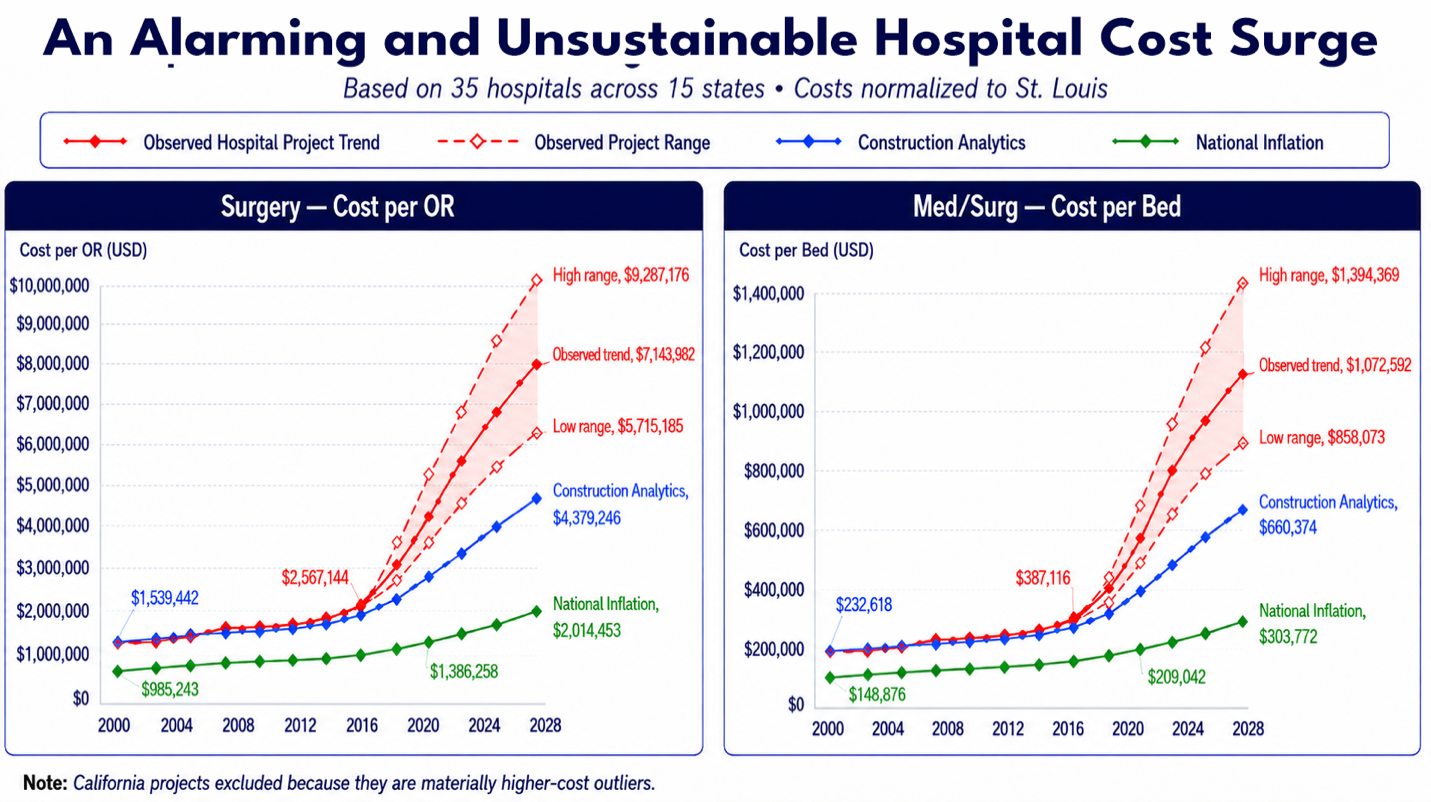
In other words, the cost of an OR, patient bed, exam room, MRI, or any of the many other hospital functions will cost commercial, private, and public (tax) payers three to seven times what inflation justifies
Is this cost phenomenon limited to hospitals or are there other buildings that are experiencing similar surges? If, so are there deeper common causes to be explored and understood? The data science is now available to provide the answer.
What if the problem is more widespread? Given our industry’s massive size and long standing productivity and waste problem, what might this portend for our nation’s economic well-being?
To put into context – our national debt is increasing by two to three trillion dollars per year and will hit a total of $40 trillion soon. By comparison, last year annual US construction volume surpassed $2 trillion, of which half or $1 trillion equates to the construction escalation value over inflation2,3. What’s happening to healthcare construction and possibly other building sectors only magnifies that burden on our economy.
Could we be heading toward an economic downturn like what the 2008 sub-prime mortgage crisis inflicted on our economy? This question deserves national attention and further investigation.
I often hear the instinctive justifications for construction’s problems, such as labor shortages, supply chain disruption, more complex facilities, increased regulatory requirements and risk aversion. All of these are true, but they predate 2018 and are already included in the escalation data that has been made public. As a result, they fail to explain the magnitude of the divergence depicted in Figure 1.
While the amount that health system owners pay for hospitals has soared, building materials and construction wage rates have escalated only modestly above general inflation for decades.
A simple calculation shows the overwhelming problem is with non-value-added scopes: supporting and indirect labor, overhead, and services. These are rarely cited as cause for concern. The industry continues to focus on direct labor as the productivity problem in need of a solution. Unless, however, an electrician pulls less wire per hour than his father did, the main problem is in the non-direct, non-value-added realm.
In their groundbreaking 2017 study "Reinventing building, the Route to Higher Productivity," the McKinsey Global Institute accused the construction industry of being stuck in a 1945 time-warp - a state of severe stagnation. According to the hospital data, we've moved past severe stagnation in the last nine years and would be much better off if we could go back to 1945 levels of production.
Although McKinsey cites several causes for our severe stagnation, our hypothesis is that "contractual frameworks and incentives are misaligned" is the chief cause.
The 35-hospital data study confirms McKinsey’s claim by showing a strong correlation between a surge in excessive costs and the expansion of misaligned contracting that applies cost-plus and/or billable-hour compensation frameworks.
In the related article Why Hospitals are in a Construction Cost Crisis the progression of layers upon layers of non-value-added costs are shown to have compounded since CM was introduced in the early 1970’s’. While the multi-layer exposition is important, the whole matter can be boiled down to two main problems:
A logical concluding hypothesis is that hospitals and other complex projects that extend cost-plus and billable hours into the second and third tiers result in the most excessive waste in time and cost.
The data shows a growing, urgent need for a construction reform movement. These four discoveries make a great case for focusing on the misaligned incentives problem:
The microeconomic data study was made possible though the research and development construction’s first Intelligent Automation System (IAS), Building CATALYST
IAS brings complexity science and multivariate analysis (MVA) resources to construction. The power of IAS and MVA includes organizing and simplifying the complex building process. For instance, we can now know the cost of an operating room or a medical surgery versus rehab patient room. All the complexity is under-the-hood, so-to-speak through layers of cause-and-effect algorithms and data stables. The IAS user is empowered with simple high level summary results or detailed comparative analysis capabilities.
For each of the 35 hospital projects around 200 data entities were collected and submitted to the IAS (CATALYST) system. The main causal groups are “Purpose and Function” (like Operating Rooms in a Surgical Department) and “Attributes” (requirements, demands, location, time and many others). These are networked to the “Outcome” (effects) groups: program, site and building metrics, schedule, and construction cost.
A worthy objective would be for the 35-hospital microeconomic data analysis be expanded to include a larger sample of current or recently completed projects that use a variety of delivery approaches, particularly second and third tier cost-plus and billable-hour compensation.
More comprehensive microeconomic data research will also provide more granular cause-and-effect relationships and discoveries. This will help clarify and measure the impact of causes, which is the first critical step in identifying and developing corrective measures/solutions. Construction reform must be centered on measurable process and value improvement.
It is understood and anticipated that any attempt to change the prevailing cost-plus and billable hour contracts will be met with stiff opposition. Not only by builders, but most consultants, architects, and engineers. Nevertheless, no matter how long it takes, the future of construction hinges on solving our mis-aligned incentives problem.
Currently, there are dozens of hospitals and other complex projects in the planning and early design stages that intend to take the cost-plus and billable hour contracting from the first tier into the second and third tiers. That’s why there’s an urgency to have these data discoveries made known before that happens. Otherwise, these projects risk wasting tens to hundreds of millions of dollars in excessive, non-value-added scope. All waste.
No matter how long it takes, the future of construction hinges on solving our mis-aligned incentives problem.
You may recognize Toyota as a world leader in auto manufacturing. You may also know of their meteor-like rise from a tiny company to worldwide dominance. However, you may be unaware of the significant influence W. Edwards Deming and his System of Profound Knowledge had on Toyota and the lean movement that followed.
Over the past few years we have pursued complex data science, especially with multivariate analysis (MVA) to translate Deming’s system to a comprehensive construction solution. The result is a standardized, integrated, and automated system for planning, design, construction, and operations. It can operate on its own, within current design-build, or IPD-like frameworks. This working solution name for this holistic platform is “Construction as a System”.
Again, the recent 35-hospital microeconomic data research provides a breakthrough in cause-and-effect analysis. The correlation between misaligned incentives and an alarming surge in cost is strong. Although subject to further data research, this breakthrough clearly paves the way for a construction reform movement to reverse construction’s decline.
Hopefully these data discoveries, combined with a clear systems-based solution, will attract systems thinkers from all parties, including owners, owner advisors/reps, consultants, architects, engineers, builders, and other influencers.
The related article, Construction Reform Requires Profound Knowledge describes how Deming’s System of Profound Knowledge is readily applicable to the construction industry. It provides an important background for leaders interested in piloting and rolling out Construction as a System. It also serves as an introduction to a curriculum to train the next generation of construction professionals.
Finally, this article, The Case for Construction as a System provides a roadmap to progressively transform construction from its compromised state to a high-performance, high-production, operationally excellent system.
When ready to try out, take next steps, or learn more, please visit www.buildingcatalyst.com.
End Notes:
1 Building CATALYST - Applying MVA (multivariate analysis) in March and April 2026 - CATALYST performed micro-economic analysis of 35 hospital projects, spanned multiple regions, owners, designers and builders, with project data anonymized for confidentiality.
2 Bureau of Labor Statistics (BLS), "Producer Price Index (PPI) for Construction Inputs and Employment Cost Index (ECI)," U.S. Department of Labor (1970–2026).
3 Ed Zarenski, Construction Inflation 2025 Update (Nov), Construction Analytics, November 13, 2025.